Emotional Intelligence for Leaders
A two-day, assessment-led programme that strengthens how leaders manage pressure, build trust and make decisions when the stakes are high.

At a glance
Learning objectives:
- Build a clear, evidence-based view of personal emotional strengths, blind spots and their impact on others.
- Manage emotional responses under pressure and respond with intent rather than reaction.
- Read the emotional tone of situations accurately and adapt communication to build trust quickly.
- Make sounder, more considered decisions in complex and high-pressure situations.
- Translate emotional intelligence into practical habits applied to real leadership challenges.
Who’s it for?
- Senior and mid-level leaders operating in high-pressure, client-facing or fast-changing environments.
- Leaders whose teams face sustained workload, burnout risk or retention challenges.
- HR and L&D teams seeking an evidence-based, assessment-led intervention for leadership populations.
- Organizations looking to strengthen well-being and performance together, rather than treating them separately.
Leaders are expected to adapt quickly, keep teams aligned and retain talent, often under sustained pressure. In these conditions, technical expertise alone does not sustain performance. The leaders who perform consistently are those who stay grounded, read complex situations accurately and make considered decisions when it matters. Emotional intelligence is the capability behind those behaviours. Where it is under-managed, the cost shows up in poorer decisions, strained relationships, disengagement and attrition. The good news is that it can be measured and developed.

Programme Overview
This programme treats emotional intelligence as a measurable leadership capability, not an abstract concept. It begins with the EQ-i 2.0 assessment, giving every participant a detailed, evidence-based map of their emotional strengths and blind spots. Over two days, leaders then build the practical capability to lead under pressure, build trust quickly and adapt with confidence. Reflection, real-time feedback, group discussion and scenario-based practice connect insight directly to the situations participants face in role.
Self-Awareness
Participants explore their emotional patterns, triggers and impact on others. Using their EQ-i 2.0 results, feedback and structured reflection, they develop a clearer understanding of how emotions shape their communication, relationships and decisions.
Emotional Regulation
Leaders practise managing emotions under pressure and responding with intent. Practical techniques for self-regulation help them stay composed in high-stakes moments, when the quality of their response has the greatest effect on the people around them.
Social Awareness
Through group discussion and scenario-based practice, participants learn to read the emotional tone of situations and respond effectively. This strengthens trust, collaboration and the ability to influence stakeholders.
From Emotional Intelligence to Business Impact
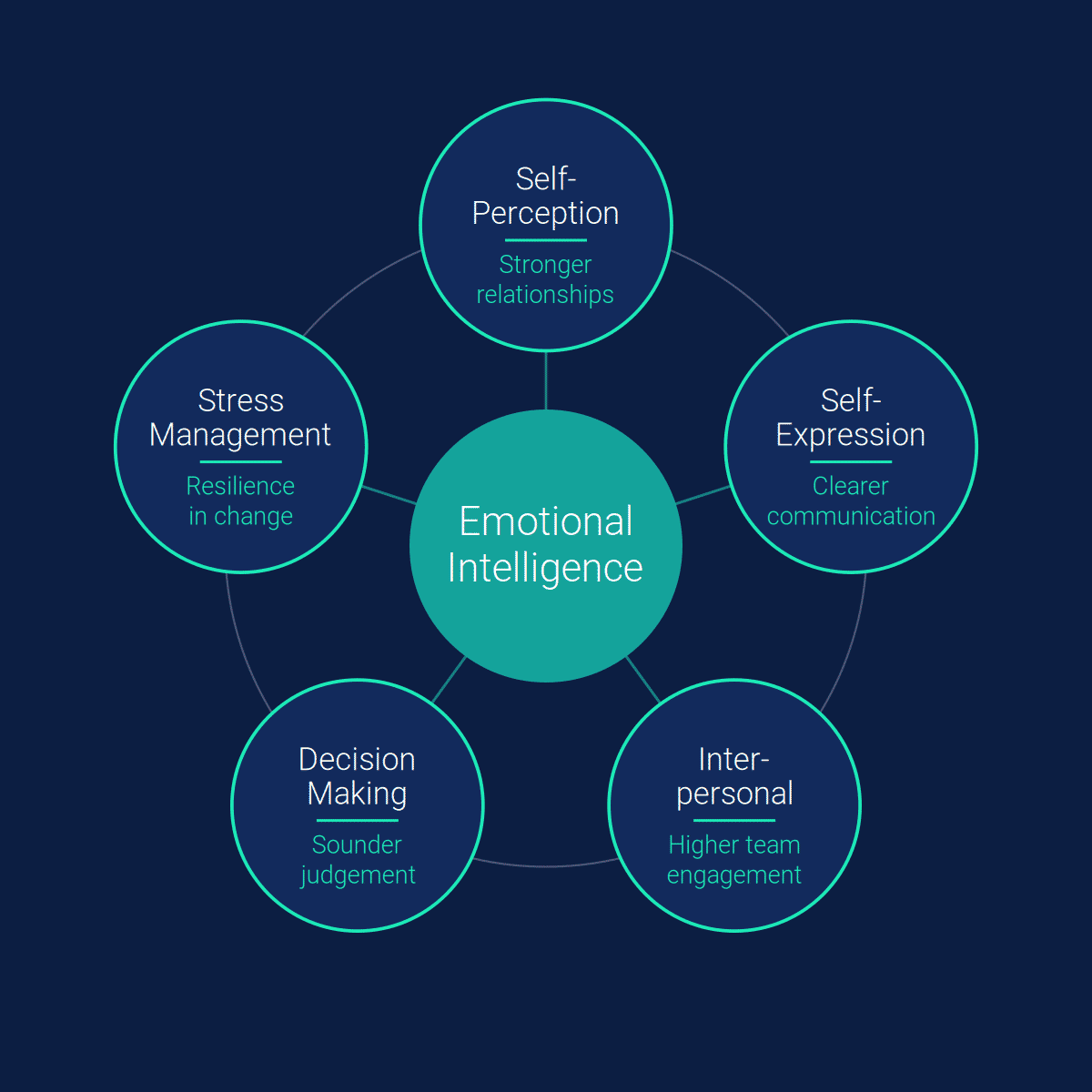
Every participant completes the EQ-i 2.0, a validated emotional intelligence assessment published by MHS. It measures five areas of emotional and social functioning, each with a direct link to leadership performance:
- Self-Perception: stronger, more authentic working relationships
- Self-Expression: clearer and more confident communication
- Interpersonal: higher team engagement and trust
- Decision Making: sounder judgement under pressure
- Stress Management: greater resilience through change
The result is a structured, evidence-based starting point for development, rather than a generic view of what good leadership looks like.
We Offer Flexibility
Emotional Intelligence for Leaders
Individual EQ-i 2.0 assessment and detailed personal report.
Two days of reflection, real-time feedback, group discussion and scenario-based practice.
Built around three core capabilities: self-awareness, emotional regulation and social awareness.
Optional 1:1 coaching to embed learning in each leader’s own context.
Designed for cohort delivery and scalable across large leadership populations.
Adaptable to your sector, leadership level and organizational context.
Got a question?
We have lots of FAQs that might help you answer your questions on this programme.

Key Benefits
Emotional intelligence shapes how leaders perform when pressure is highest: in difficult conversations, under competing demands and through periods of change. Strengthening it improves decision quality, team engagement and retention, reducing the performance risk that sits in how leaders respond, not just what they know.

Leaders who stay composed and make sound decisions under pressure
Stronger working relationships and faster trust-building with teams and stakeholders
Higher team engagement, supporting the retention of key talent
Greater resilience through change and sustained workload
A team climate built on trust, where people want to stay and perform
A measurable baseline of emotional intelligence capability through the EQ-i 2.0
Are you interested in this programme?
Get in touch here, whether you want more information about the programme, speak to our leaders or book the programme.



Case Study
Emotional Intelligence for Future Leaders
Inspirational Group partnered with a Big Four consulting firm to deliver a two-day Emotional Intelligence programme for 500 leaders in India, enhancing self-awareness, resilience, and leadership impact.


Future Airport Leaders Programme: Building the Next Generation of Leaders in a Major Middle East Airport
Building leadership capability and behavioural precision for the next generation of airport leaders.
VIEW CASE STUDY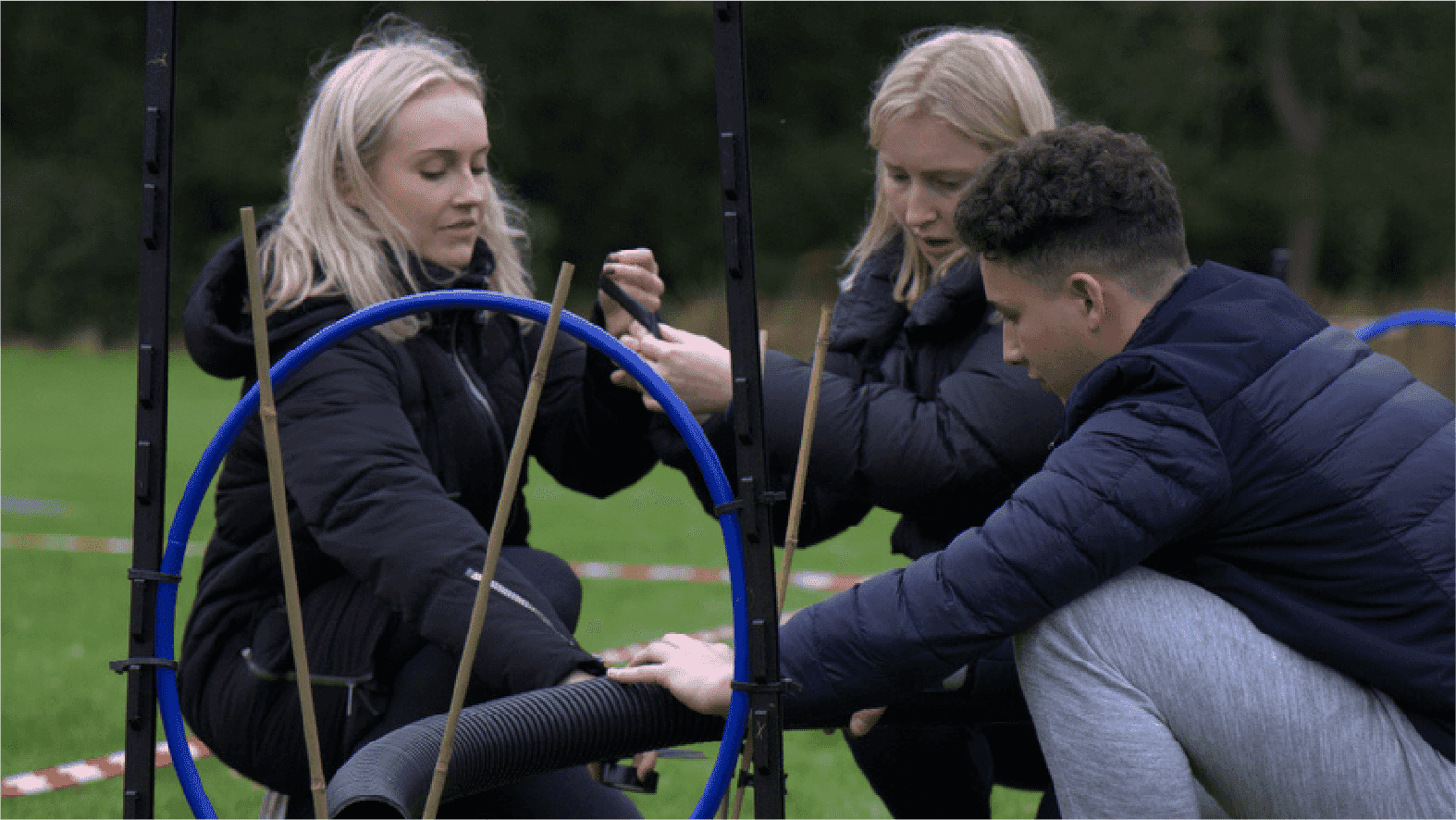
Graduate Programme: Inspiring Effective Followership
Through an immersive two-day event at the Royal Military Academy Sandhurst, Inspirational Group helped graduates develop self-awareness, collaboration, and leadership followership skills that set the…
VIEW CASE STUDY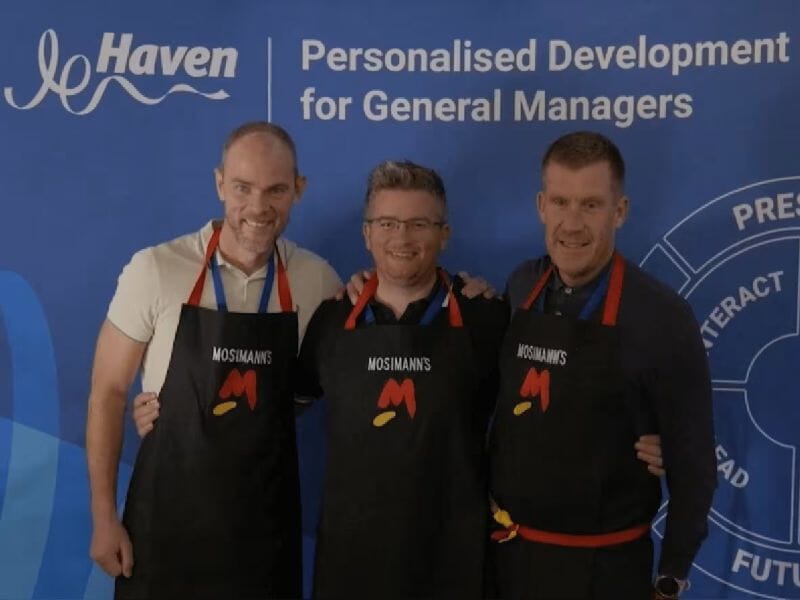
Inspiring Leadership Excellence Across the UK’s Favourite Holiday Parks
A multi-module leadership journey designed to develop confident, emotionally intelligent General Managers capable of delivering exceptional guest experiences, high-performing teams, and commercial success.
VIEW CASE STUDYFAQs
Emotional intelligence is the ability to recognise, understand and manage emotions in yourself and others. For leaders, it directly influences decision quality, relationships, team engagement and resilience under pressure. Where it is under-developed, the effects are commercial as well as personal: poorer decisions, disengagement and the loss of key talent.
Yes. Emotional intelligence is not a fixed trait. It is a set of skills that can be measured, developed and applied. The programme uses a validated assessment to establish a baseline, then builds capability through structured practice and feedback.
The EQ-i 2.0 is a validated emotional intelligence assessment published by MHS. It measures five areas: Self-Perception, Self-Expression, Interpersonal, Decision Making and Stress Management. Each participant completes it before the programme and receives a detailed personal report, which is used throughout the two days to ground development in evidence.
It is designed for leaders operating under sustained pressure, from mid-level managers to senior leaders and partners. It is particularly relevant in client-facing, fast-changing or high-demand environments where composure, judgement and relationships have a direct effect on performance.
Following the workshop, participants can take part in 1:1 coaching with an accredited coach. Sessions focus on applying the learning in each leader’s own context, embedding new habits and working through specific challenges.
The programme helps leaders recognise and manage pressure more effectively, both for themselves and their teams. Strengthening emotional regulation and social awareness supports healthier team climates and can reduce the effects of sustained stress. It is a leadership development programme, not a clinical or mental health intervention.
Yes. Scenarios, examples and emphasis can be adapted to your sector, leadership level and the specific pressures your leaders face, so the learning is immediately relevant.
Leaders typically report stronger control under pressure, clearer communication, improved team engagement and sharper decision-making. In one deployment with a Big Four consulting firm, the programme has been delivered to 500 Partners and Directors across 20 cohorts annually, with consistently strong participant feedback.
Yes. The programme is currently delivered in India and can be delivered across the UK, Europe and the Middle East.