Change Progress Meter: AI Enablement Case Study

At a glance
Dr. Marcus Gottschalk was invited to speak at a senior HR leadership event at a global leader in real estate services and investment management. He offered to trial the Change Progress Meter on a live change initiative within their organization. They chose their AI Enablement transformation project, and 15 attendees volunteered to take part.
This is a point-in-time snapshot from a self-selected group, with no prior benchmark to compare against. Inspirational Group has been invited back in June 2026 to conduct a second round of interviews and measure how the change has progressed.
Goal:
Understand how a major AI Enablement project was being experienced across the organization and identify where progress was being blocked.
Delivery:
AI-enabled interviews analysed using the Change Progress Meter and SAILING Change Model framework.
Sector:
Real estate services and investment management
Scope:
15 structured stakeholder interviews conducted across multiple geographies and business functions.
Region
Global, multi-country
Type:
Technology and AI Enablement
The Challenge
High individual enthusiasm. Organizational progress stalling.
A global leader in real estate services and investment management was rolling out a significant AI Enablement initiative across multiple countries. Leadership could see strong engagement signals at the individual level, but lacked a structured, evidence-based view of how the organization as a whole was progressing.
Without that visibility, it was difficult to identify where structural or behavioural friction was building, which markets were at risk of falling behind, and where intervention was needed before problems became costly.
The organization needed more than survey data. They needed insight that was timely, psychologically informed, and actionable at a leadership level.
The Context
A decentralised model creating structural tension.
The organization operates across highly independent country markets. This decentralised structure, while commercially effective, was creating friction in the change project. Different regions were pursuing separate approaches, without a unified framework to align effort or measure progress consistently.
At the same time, individual employees were not waiting. Many were already using AI tools daily to improve their own productivity, often without organizational support or governance. The energy was there. The alignment was not.

Our Approach
Structured insight through the Change Progress Meter.
Inspirational Group deployed the Change Progress Meter across 15 stakeholder interviews, using the SAILING Change Model as the analytical framework. AI-enabled interview analysis allowed us to move quickly, surfacing both quantitative progress indicators and qualitative behavioural themes with precision.
The result was a structured, evidence-based picture of where the organization stood, how individuals were experiencing change, and where the critical risks to progress were concentrated.
Rather than a static survey, this approach gave leadership a dynamic view of the change landscape, grounded in real employee experience and linked directly to behavioural risk.
Organizational progress
Where the organization sat across the four SAILING Change Model phases, from Initialising through to Reflecting and Anchoring.
Individual progress
How far individual employees had personally progressed, independent of the organization’s pace, revealing the execution lag.
Resistance profiling
The nature and distribution of resistance across the stakeholder group, from active support through to active resistance.
Qualitative risk themes
Structured analysis of the behavioural and structural themes emerging from interview data, mapped to actionable leadership priorities.
What the Data Revealed
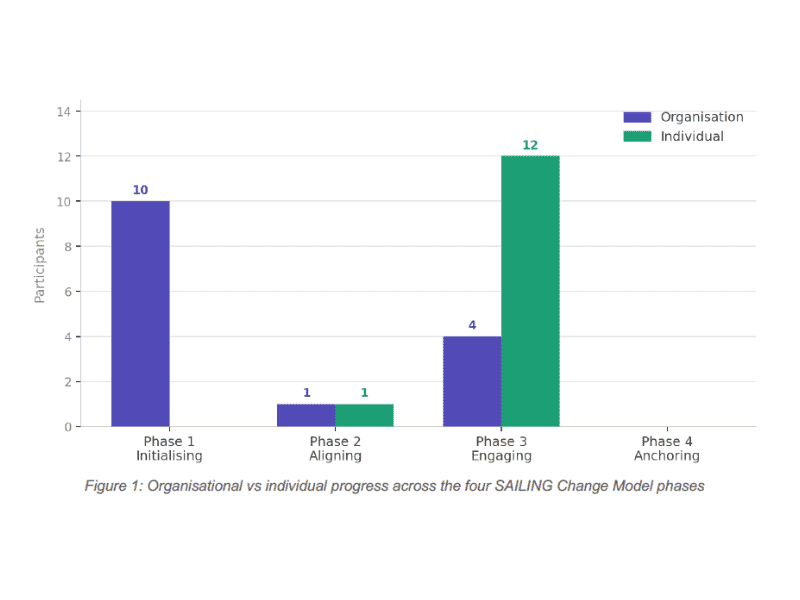
80% of individuals were already actively embracing change, personally in phase 3 of the SAILING model vs 67% felt the organization itself had not yet left the harbour, still in phase 1 of the SAILING model.
The execution lag is one of the most common and costly patterns in change leadership. When individuals are ready to move but the organization cannot keep pace, motivation erodes, flight risk increases, and the momentum of early enthusiasm is lost. Without structured measurement, this gap is invisible until it is too late to act.
- The decentralisation anchor
Country independence was creating severe structural friction. Different regions were pursuing separate approaches, without a unified enterprise framework. Until local versus global alignment is resolved, collective progress stalls. - Grassroots momentum and shadow adoption
Individuals were not waiting for the organization. Many were already building their own workflows and approaches daily. Without governance, this energy risks becoming fragmented and impossible to scale. - Change fatigue and senior leadership gaps
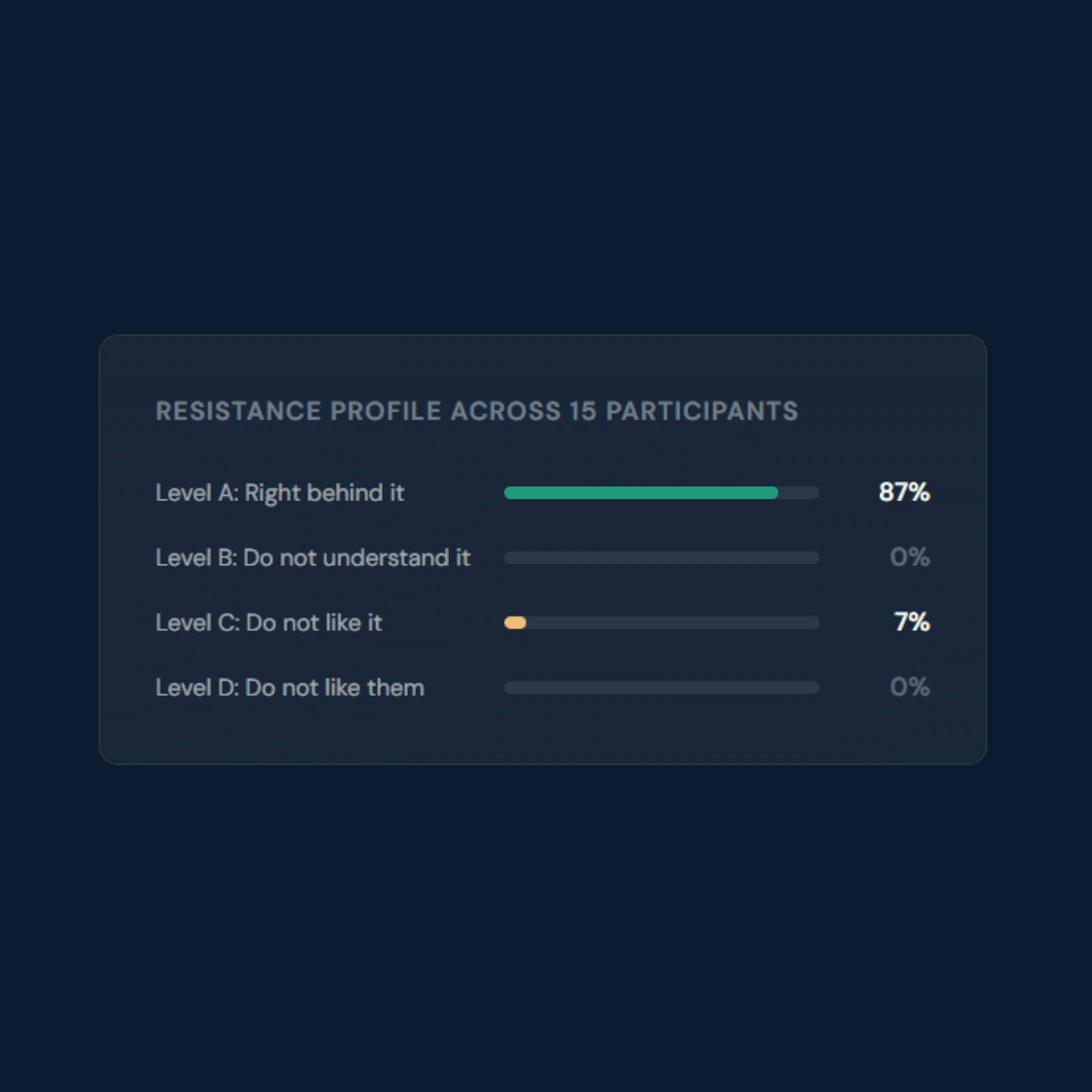
The small proportion of resistance that did exist was driven by exhaustion, not opposition. Senior leaders not visibly engaging with the change were perceived as blockers, creating flight risk among the most capable employees.
From insight to leadership action.
The value of the Change Progress Meter is not the data itself. It is what the data makes possible. When leaders can see clearly where their organization and their people actually are, they can intervene with precision rather than assumption.
In this engagement, three clear priorities emerged from the data. Each addressed a specific barrier and mapped directly to a structured intervention recommendation, giving leadership a clear and commercially grounded basis for action.

Resolve the global versus local alignment gap
Formalise grassroots momentum
Address senior leadership credibility gaps
Identify and act on change fatigue before it becomes flight risk
Create a unified map for the change, whilst respecting local implementation needs
Move from assumption to evidence in leadership decision-making
Establish a measurable baseline to track progress over time
Intervene early, whilst the change is still underway
Dr. Marcus Gottschalk has been invited back in June 2026 to conduct a second round of interviews using the Change Progress Meter. This will allow the organization to measure how the change has progressed since the initial baseline, identify whether the structural and leadership risks have been addressed, and track shifts in both individual and organizational readiness. It will mark the first re-measurement cycle for this engagement.
you may also like...
Change Progress Meter: AI Enablement Case Study
How the Change Progress Meter gave senior leaders structured, real-time insight into how a major AI Enablement initiative was being experienced across a global organization.
VIEW CASE STUDY
The Change Leadership Suite in Action: Building Change Leadership Capability Across 16,000 Leaders Worldwide
A global automotive manufacturer needed to build change and transformation capability across 16,000 leaders worldwide. This case study outlines how a structured, maturity-based skill line,...
VIEW CASE STUDY
From Passive Learning to Applied Change Leadership in Financial Services
A bespoke virtual programme helping financial services leaders build real change capability through applied, experience-led learning.
VIEW CASE STUDY