Why Annual Planning Seasons Produce Alignment Theatre Rather Than Aligned Execution

There is a pattern I have noticed playing out in organizations of every size and sector, and it happens with enough regularity that I have started to think of it as one of the most expensive rituals in corporate life. A leadership team books two or three days away from the office, works through the priorities, debates the direction, and produces something that by the end of the final afternoon genuinely feels shared. People travel home feeling that the year ahead has been mapped with real clarity.
Within a matter of weeks, the organization carries on more or less exactly as it did before.
The strategy exists on paper. The decisions people make on a Tuesday afternoon, the projects that get protected when budgets tighten, the behaviour that leaders model when the pressure comes on: none of this changes to reflect what was agreed in the room. I have come to call this alignment theatre, by which I mean the organizational performance of planning without the conditions that make planning translate into action.
This is not a niche problem. Research by the Harvard Business Review found that 67% of well-formulated strategies fail in execution, and 61% of senior leaders acknowledge that their organizations struggle to bridge the gap between strategy formulation and day-to-day implementation. Given those numbers, the surprising thing is not that execution fails so often. It is that so few organizations look seriously at why.
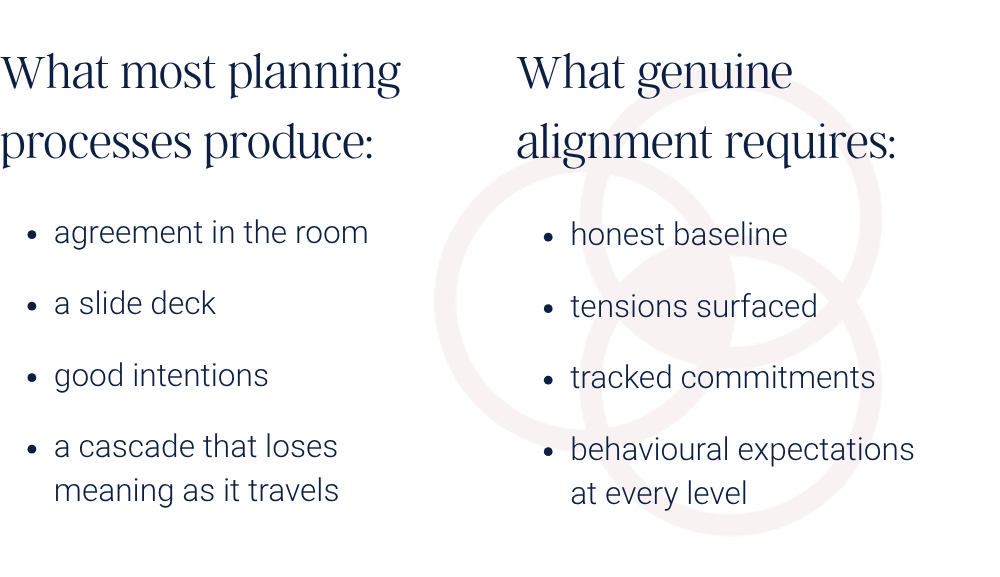
The problem starts with what planning processes are actually designed to produce
Most planning processes are designed to produce agreement. Agreement is not the same thing as alignment, and the difference matters enormously in practice.
Agreement means that the people in the room have said yes to a set of priorities and a direction of travel. Alignment means that those priorities are understood in the same way by everyone at the table, that the trade-offs they imply have been worked through honestly, that there is a shared picture of what will actually need to change, and that the leadership team has examined its own dynamics honestly enough to know whether it is genuinely pulling in the same direction.
Agreement is relatively straightforward to achieve in a well-structured offsite setting. A competent process, a clear agenda and enough goodwill in the room will usually get you there. Alignment is considerably harder. It requires a kind of conversation that most planning agendas do not make space for, one that surfaces the tensions and competing assumptions that exist within the team and works through them directly rather than setting them aside in the interests of producing a coherent plan.
The tensions that do not get surfaced during the planning process do not disappear. They travel back to the office alongside everyone else and emerge during execution as the friction, inconsistency and mixed messaging that people at every level of the organization experience as the gap between what leadership says and what it actually does.
Three things that consistently undermine execution before it starts
The first is what I would describe as interpretation drift. When strategy is communicated through a cascade, each layer of the organization processes it through its own lens: its existing priorities, its reading of what leadership actually values, its sense of what is realistic given the pressures it is under day to day. By the time the message reaches the people who need to act on it, it has often been reshaped in ways that are genuinely difficult to trace. This is not a failure of communication in the narrow sense. It is a predictable consequence of asking people to make sense of new information without giving them the tools or the conversation time to do so accurately.
The second is the persistence of legacy commitments. Organizations do not run on clean slates. When a new set of strategic priorities is announced, there are projects already in flight, processes that have been running for years, and expectations from stakeholders that predate whatever was decided at the offsite. A new strategy does not automatically displace any of this. Without explicit decisions about what to stop, what to deprioritise and what to protect, people will rationally continue doing what they were already doing. The new priorities get added to an existing workload rather than replacing any part of it, and within a few months it is the new strategy that has been quietly deprioritised rather than the legacy commitments.
The third is the gap between what leaders say and what their behaviour signals. This is the factor that matters most, and the one that is most rarely discussed with real honesty in a planning process. When leaders allocate their time, attention and resource in ways that do not reflect the stated priorities, the rest of the organization notices, and notices faster and more accurately than most leaders appreciate. The informal intelligence systems of an organization are considerably more sensitive than the formal ones. If the strategy says that developing people is a priority, and then every conversation about the development budget becomes a negotiation about cutting it, people draw the correct conclusion: the strategy is a document, not a commitment.
What genuine alignment requires
The first thing it requires is an honest baseline. Before any planning conversation can be genuinely useful, a leadership team needs a clear and accurate picture of where the organization actually is: what behaviours are in place, where the gaps between intent and reality are concentrated, and where the friction in execution is coming from. Without this, planning is conducted on the basis of assumptions, and those assumptions are often wrong in ways that are difficult to identify without structured data. Our Organizational Performance Insight diagnostic was designed specifically to provide this kind of evidence base before the planning work begins, so that the conversations in the room are grounded in what is actually happening rather than what leadership believes or hopes is happening.
The second is that the planning process itself needs to create space for the leadership team to surface and work through the tensions that exist at the top before they are cascaded downwards. This is not comfortable work, and it does not happen naturally within a structured agenda that has been designed to produce a plan. It requires an external facilitator who is genuinely outside the dynamics of the team, who can hold space for honest conversation without being invested in any particular outcome.
The third is that the outputs of the process need to be translated into specific behavioural expectations at every level of the organization, not just communicated as strategic priorities. What does this strategy mean for how we lead? How do we make decisions when two important things are in conflict? What does good look like in terms of how people work together day to day, and how will anyone know if the organization is falling short of it? These are questions that most planning processes do not answer, and their absence is precisely where execution runs into difficulty.
On the design of the offsite itself
The annual planning offsite is not going away, and there is good reason for that. Time away from the operational environment, with a focused agenda and proper facilitation, is one of the highest-leverage investments a leadership team can make. Two or three days of structured work, genuinely away from the pull of normal working life, can shift the trajectory of an organization in ways that months of internal meetings cannot.
The question is not whether to do it. It is how to design it so that what comes out of it is more than an agreed set of slides.
At Inspirational Group, we work with leadership teams to design offsite experiences that begin with an evidence base rather than an assumption, that are structured to surface the tensions that need resolving rather than smoothing them over, and that produce specific commitments about what will change rather than simply a set of agreed priorities.
The design of the environment and the structure of the experience matters considerably more than most organizations realise when they are planning these sessions. In our work with a global industrial manufacturing client, we built an overnight simulation as the centrepiece of the senior executive programme, running from late afternoon through to the following morning. The explicit intent was to test decision-making and character not in optimal conditions but when people are tired, under pressure and facing escalating complexity. A senior leader with 28 years at the business described it as the most useful management development experience of his career. That observation says something significant about the gap between what a conventional planning process achieves and what a properly designed experience can produce. You can read more about our approach to simulation-based leadership development here.
The work does not end when people travel home. Commitments made in the room need to be tracked, reviewed and adjusted as the year develops. The gap between a productive offsite and sustained behavioural change is precisely where most planning investments are lost, and building in the structure to close that gap is as important as the design of the event itself.
You can find out more about our leadership development and facilitation work here, and explore some of the work we have done with organizations facing similar challenges to get a sense of how we work in practice. If your planning season is approaching and you want to approach it differently, we would be glad to talk through what that might look like for your organization.
FAQs
The most common reason is that the planning process is designed to produce agreement rather than genuine alignment. A leadership team can leave a planning session having said yes to a set of priorities and still hold fundamentally different understandings of what those priorities mean in practice, what they imply for how the organization needs to work, and which existing commitments they should displace. Those differences surface during execution as friction and inconsistency that is difficult to trace back to its source. Research by the Harvard Business Review suggests that 67% of well-formulated strategies fail in execution, which means this is not an unusual outcome. It is the default unless something specific is done to address the gap between planning and behavioural change.
Agreement means that the people in a planning session have said yes to a set of priorities and a direction of travel. Alignment is harder to achieve and more valuable. It means that those priorities are understood in the same way by everyone involved, that the behavioural implications have been worked through honestly, and that there is a shared picture of what will actually need to change. You can reach agreement in a single afternoon with the right process. Alignment typically requires a different kind of conversation, one that is willing to surface and work through the tensions and competing assumptions that exist within a leadership team rather than setting them aside to preserve the coherence of the plan.
Two to three days is generally the minimum for a leadership team that wants to produce more than a reviewed and ratified plan. The first day tends to be largely occupied with getting people genuinely out of operational mode and into a different quality of conversation, and this takes longer than most planning processes budget for. The substantive strategic work tends to happen on the second day. The third day, where it exists, is where commitments can be translated into specific behavioural expectations and concrete actions. Shorter offsites tend to produce agreement rather than alignment, because there is simply not enough time to work through what alignment requires.
The most important thing is a structured process for translating what was agreed into specific behavioural expectations at every level of the organization. This is not a communications exercise. It involves working with each layer of the organization to answer a specific question: what does this strategy mean for how we work, how we prioritise, and how we make decisions in this part of the business? Without this translation, the gap between strategic intent and daily behaviour opens up almost immediately. Beyond this, the commitments made during the planning process need to be tracked and reviewed as the year develops, with enough structure that drift becomes visible before it becomes entrenched.
A diagnostic run before the planning process gives the leadership team an accurate, evidence-based picture of where the organization currently is: which behaviours are in place, where the gaps between stated intent and actual practice are concentrated, and where the friction in execution is coming from. Without a baseline of this kind, planning conversations are conducted on the basis of leadership assumptions, and those assumptions are often inaccurate in ways that are difficult to identify from inside the system. A good diagnostic also tends to surface the tensions within the leadership team that most need to be addressed during the planning process itself, which means the time in the room is spent on the things that actually matter rather than the things that are easiest to agree on.
More than most leaders appreciate, and more quickly than most would expect. People throughout an organization consistently read the allocation of leadership time, attention and resource as the most reliable signal of what the organization actually values, and they adjust their own behaviour accordingly. When leadership behaviour visibly aligns with stated strategic priorities, it creates a powerful reinforcing signal throughout the system. When it does not, the effect runs in the opposite direction: the strategy is understood as aspirational rather than operational, and people default to what they can see is genuinely valued based on what they observe. Addressing this honestly is one of the most valuable things a well-designed planning process can create space for.
You may also like...

Many men are unprepared for menopause, and few see a role for themselves in supporting it. Yet leaders influence whether women are supported or withdraw...
VIEW ARTICLE
Four programmes for 2027 planning: aligning leadership teams on measurable priorities, building emotional intelligence under pressure, developing people managers and growing the pipeline of women...
VIEW ARTICLE
A strategy planning session usually ends with a deck and a shared sense of direction. Here is what a leadership team should leave with to...
VIEW ARTICLE