Leadership Development ROI: What 19 Years of Evidence Actually Shows

There is a question that sits at the heart of every leadership development investment: does it actually change anything?
Not in the room. Not on the day. But months later, years later, a decade on: does the behaviour shift? Does it hold? Does it compound?
After 19 years of delivering FUSION, a year-long leadership development programme for HSBC, we have a considered answer. And the evidence, drawn from a structured alumni review conducted at the programme’s 15-year milestone, is more compelling than we anticipated.
The Programme, In Brief
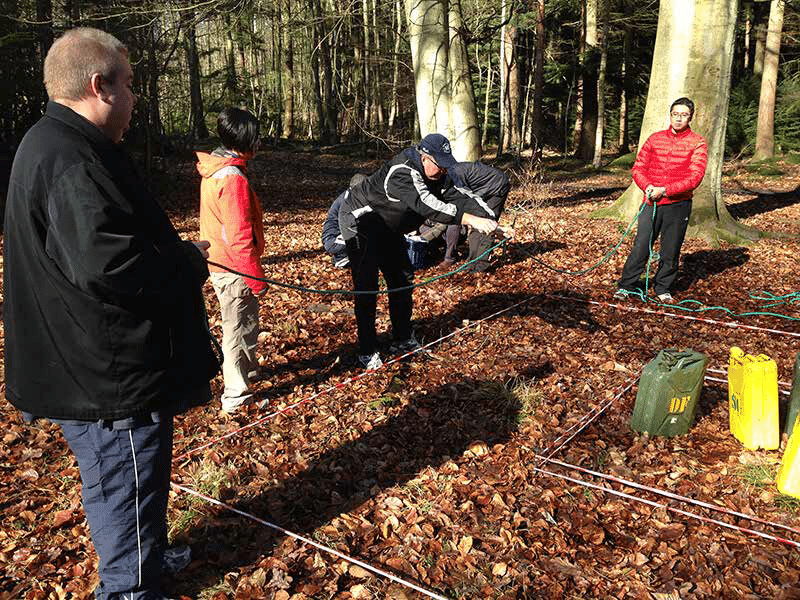
FUSION was designed to develop high-potential leaders through a combination of experiential learning, action learning teams, collaborative projects, and structured behavioural challenge. At the point of its 15-year review, it had run across 35 iterations, engaged 1,096 participants drawn from technology and business functions across global operations, and delivered 140 cross-functional projects.
The estimated return on those projects, at that point, exceeded $115 million.
But the ROI figure, whilst significant, is not the most instructive part of the story.
What the Data Actually Shows
When we surveyed FUSION alumni to assess the programme’s lasting impact, the results were consistent across multiple dimensions.
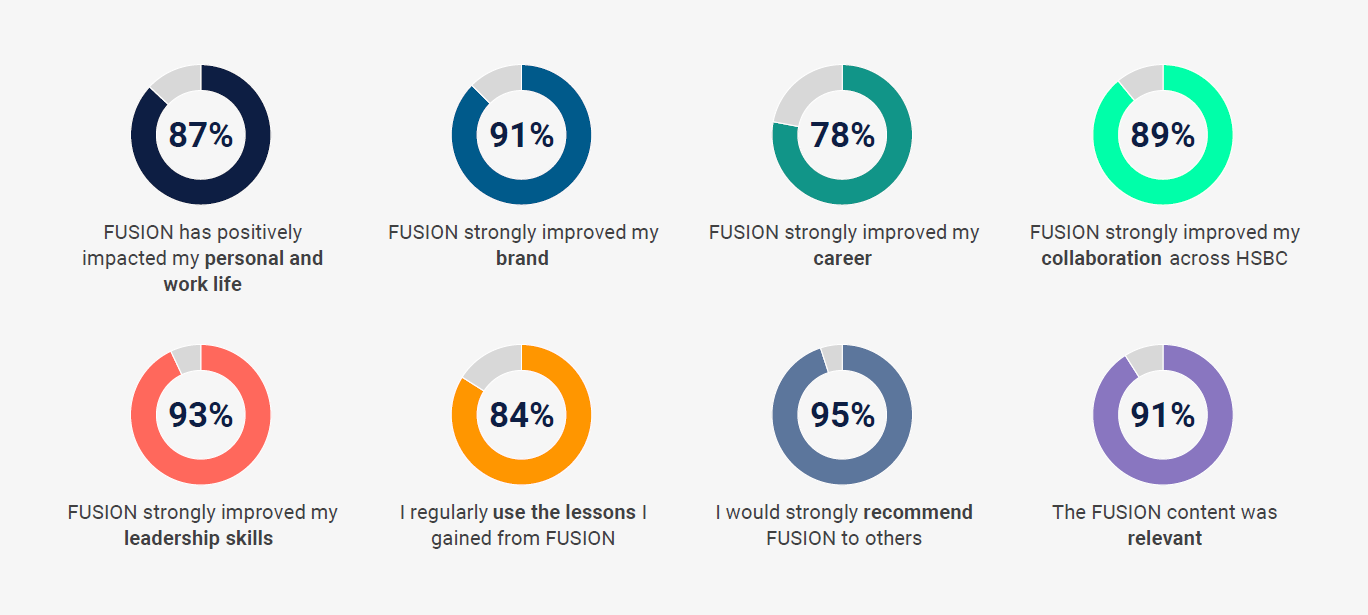
95% said they would recommend the programme to others. 91% rated it directly relevant to their situation. 84% reported they regularly use the lessons gained. And 89% said FUSION strengthened their ability to collaborate across the organization.
These are not post-programme satisfaction scores. These are retrospective assessments from leaders reflecting on a development experience, often years after completing it.
What they point to is not a well-received training event. They point to a shift in capability that embedded itself in professional practice.
The Behaviour That Actually Changed
When alumni described what FUSION changed, 30 distinct skill areas emerged. But several themes recurred with notable consistency.
Collaboration across boundaries. Almost 90% of participants identified cross-functional collaboration as a direct outcome. Participants described forming relationships across geographies, functions, and seniority levels, and the confidence to use those relationships in practice.
Leadership identity, not just leadership skill. 84% reported a significant increase in their leadership capability. But the language participants used was revealing. They did not describe acquiring techniques. They described a shift in how they saw themselves as leaders: the confidence to step forward, to take accountability, to lead with greater intention.
Career trajectory. More than 40% could identify specific promotion and enhanced career opportunities directly connected to their participation in FUSION. This is not a soft outcome. It is a measurable indicator of behavioural change recognised and rewarded by the organization.
Three Participants, Years Later
The most instructive evidence comes not from survey data, but from individual accounts: senior leaders reflecting on what changed, and why it held.
A CIO in financial services, who joined FUSION as a global programme manager, described the programme as a catalyst for personal and professional transformation. Their ALT project involved organising 33 participants to walk 100 kilometres to fund the construction of a school in Africa. It grew into an ongoing initiative that has since delivered seven schools across multiple countries. The project required cross-cultural coordination, stakeholder engagement, senior sponsorship, and sustained execution over years. It was, in practical terms, a real leadership challenge with real consequences.
A CTO in wealth and retail banking, who joined FUSION at a point of professional uncertainty, now oversees a team of around 500 people. She is direct about the source of what changed: not subject expertise, but confidence. “What FUSION did was give me that confidence to know that I was good enough.” Her ALT project, a global hackathon built on a new API platform, predated the widespread adoption of open API architecture in financial services by several years.
A CEO of a digital transformation consultancy, who joined FUSION as a programme manager before progressing to CIO, identified self-discovery and the ability to adapt behaviour to context as the programme’s most enduring contribution. She was also precise about what made it structurally effective: “It’s not a course that you do and then forget. You have to go back and work with people. You build strong relationships with people who get to know your world, and you can use them as trusted people you can have a discussion with in a language you both share.”
Three participants. Three different functions, geographies, and career trajectories. A consistent pattern: behaviour changed, held, and compounded.
What This Tells Us About Leadership Development
The evidence from FUSION supports several conclusions that we believe are relevant to any organization investing in leadership capability.
Duration matters. A year-long programme creates accountability structures that a two-day workshop cannot. Participants cannot disengage after the residential. The learning is distributed, applied, and returned to, which is precisely how behavioural change becomes embedded.
Real work is the development. The collaborative project component of FUSION was not an analogy for real leadership challenges. It was a real leadership challenge, with genuine stakeholders, genuine constraints, and genuine consequences. Several of the 140 projects delivered outcomes that were ahead of their time: corporate sustainability initiatives, mental health-focused interventions, technology platforms that anticipated industry shifts. The development happened through the work, not alongside it.
Measurement is part of the design. The survey data we gathered at the 15-year mark was not an afterthought. It reflects a consistent orientation: that impact should be assessed, not assumed. Performance improvement is demonstrated, not declared.
Behavioural change requires a holding environment. The alumni network created by FUSION became, in itself, a performance asset. Participants described using it as a sounding board, a source of trusted challenge, and a network with shared language and shared standards. That network was not incidental to the programme’s impact. It was structural to it.
The Honest Reflection
Not every project delivered commercial returns at scale. Not every participant experienced the same degree of change. And the world that FUSION alumni now operate in, shaped by hybrid working, AI-enabled operations, and accelerating organizational complexity, is materially different from the one the programme was designed for.
That is why the alumni survey also asked participants to look forward: what would a refreshed FUSION need to address? The responses pointed to resilience and robustness under pressure, leading distributed and remote teams, mental health and wellbeing, and the practical application of inclusion. These are not peripheral leadership topics. They are central performance challenges for today’s organizations.
The Underlying Argument
The commercial case for investing in human performance is not primarily a talent retention argument, though the data supports that too. It is a productivity and execution argument.
Organizations that actively manage the behavioural system, the way people collaborate, make decisions, lead under pressure, and adapt to change, tend to outperform those that treat behaviour as incidental to strategy. Performance risk often sits in the human system, not in the strategy itself.
FUSION, now in its 19th year, is one of the more sustained demonstrations of that argument we have encountered. The evidence is structured, longitudinal, and named.
Inspirational Group is a human performance advisory and delivery partner. We integrate behavioural expertise, data-enabled insight and structured measurement to help organizations strengthen the behaviours that drive execution and productivity.
To discuss how a structured leadership development programme might be designed for your organization, start a performance conversation with our team.
FAQs
The figure represents a blend of three categories of financial impact generated by participant project teams during the programme: revenue uplift, cost reduction, and cost avoidance. The majority of the total is attributable to cost reduction.
Each project team was required to quantify the impact of their work. To illustrate how those figures were arrived at, consider four representative examples. One project identified that data centre temperatures could be raised within safe operating parameters, reducing energy consumption and delivering savings of around $60,000 per month on an ongoing basis. A second engaged external specialists to renegotiate supplier contracts on a no-win, no-fee basis, delivering cumulative savings of $6.4 million over five years. A third introduced water-saving technology across office facilities, generating estimated savings of $3 million. A fourth identified an inefficiency in how replacement card expiry dates were issued, correcting this to deliver savings of approximately $1 million per year. These are not outliers. They are representative of the range and type of projects delivered across 35 iterations.
Inspirational Group’s programme fees were approximately $300,000 per iteration. Across 35 iterations, that represents a total investment of around $10.5 million in programme fees. Against a conservatively estimated $115 million in project-generated returns, that implies a payback ratio of better than 10:1 on fees alone.
It is worth noting that this calculation covers only the directly quantified project outcomes. It does not attempt to assign financial value to the leadership capability, career progression, or organizational collaboration that participants consistently reported.
Project teams were required to present their outcomes to senior sponsors at the conclusion of each iteration, with financial impact figures subject to review by those sponsors. Whilst the methodology varied by project type, each team was held accountable for the credibility of its claims. The $115 million figure represents the aggregate of those sponsor-reviewed outcomes across the programme’s history.
The survey was designed and distributed by Inspirational Group to as many FUSION alumni as could be contacted at the programme’s 15-year milestone. It was structured to assess retrospective impact across several dimensions: relevance, skill development, career progression, collaboration, and likelihood to recommend. Results reflect the responses of participants across multiple iterations, geographies, and functions, many of whom completed the programme several years prior to being surveyed.
You may also like...
Most leadership development programmes teach people what to think. Leadership simulation exercises put them in conditions where they have to think, decide and act. Under...
VIEW ARTICLE
AI is rapidly becoming embedded in everyday work. The real challenge for organizations is no longer technology adoption, but how leaders exercise judgement and governance...
VIEW ARTICLE
Most organizations track activity during change. Few truly measure change progress. When reporting masks drift, leaders lose visibility until the cost is already embedded.
VIEW ARTICLE