Leadership Masterclass Recap: Psychological Safety and Courageous Leadership

At our September Leadership Masterclass, we explored two powerful and connected themes: psychological safety and courageous leadership. These concepts lie at the heart of high performing teams, and when leaders model them effectively, they create an environment where people can take risks, speak up, and thrive.
What do we mean by psychological safety?
Drawing on the work of Amy Edmondson, psychological safety is the belief that you will not be punished, humiliated, or ignored for speaking up, sharing ideas, or admitting mistakes.
It is:
- Candour and honesty: people can speak freely.
- Learning and innovation: mistakes become opportunities for improvement.
- Voice and inclusion: everyone feels listened to.
It is not about consensus, comfort, or avoiding conflict. At its core, psychological safety is a catalyst for excellence rather than an end in itself.
What does psychological safety mean to you?
During the session, participants shared what came to mind when they heard the phrase psychological safety. Using a live Mentimeter poll, words like trust, support, care, and kindness emerged most strongly, alongside ideas such as innovation, being authentic, courageous conversations, and sharing views without fear.
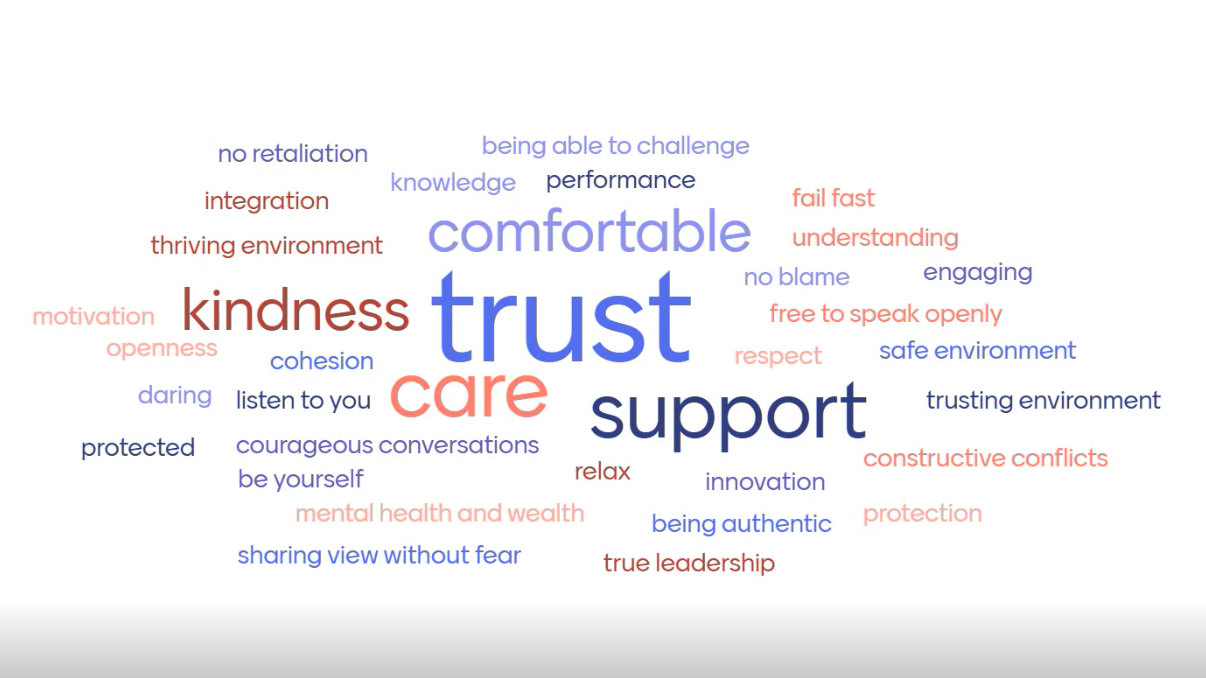
While many responses were positive, some participants also raised terms like no retaliation and protection. This highlighted an important truth: the fact that retaliation even comes to mind suggests that in some workplaces, people still fear consequences for speaking up.
The diversity of responses showed that psychological safety is understood in many different ways. This made it all the more valuable to return to Amy Edmondson’s definition, which frames psychological safety as the belief that you will not be punished, humiliated, or ignored for sharing ideas or admitting mistakes.
Why does it matter?
Google’s landmark Project Aristotle revealed that out of five factors that drive team success, dependability, structure, meaning, impact, and psychological safety, the single biggest predictor of high performance was psychological safety. When people feel safe to take interpersonal risks, every other factor is strengthened.
The outcomes are clear:
- Innovation: people experiment and take smart risks.
- Reliability: work improves and errors decrease.
- Inclusion: more voices are heard.
- Performance: teams deliver more, and better.
The role of courage in leadership
Without psychological safety, courage is risky. Speaking up might harm relationships, reputation, or even someone’s job.
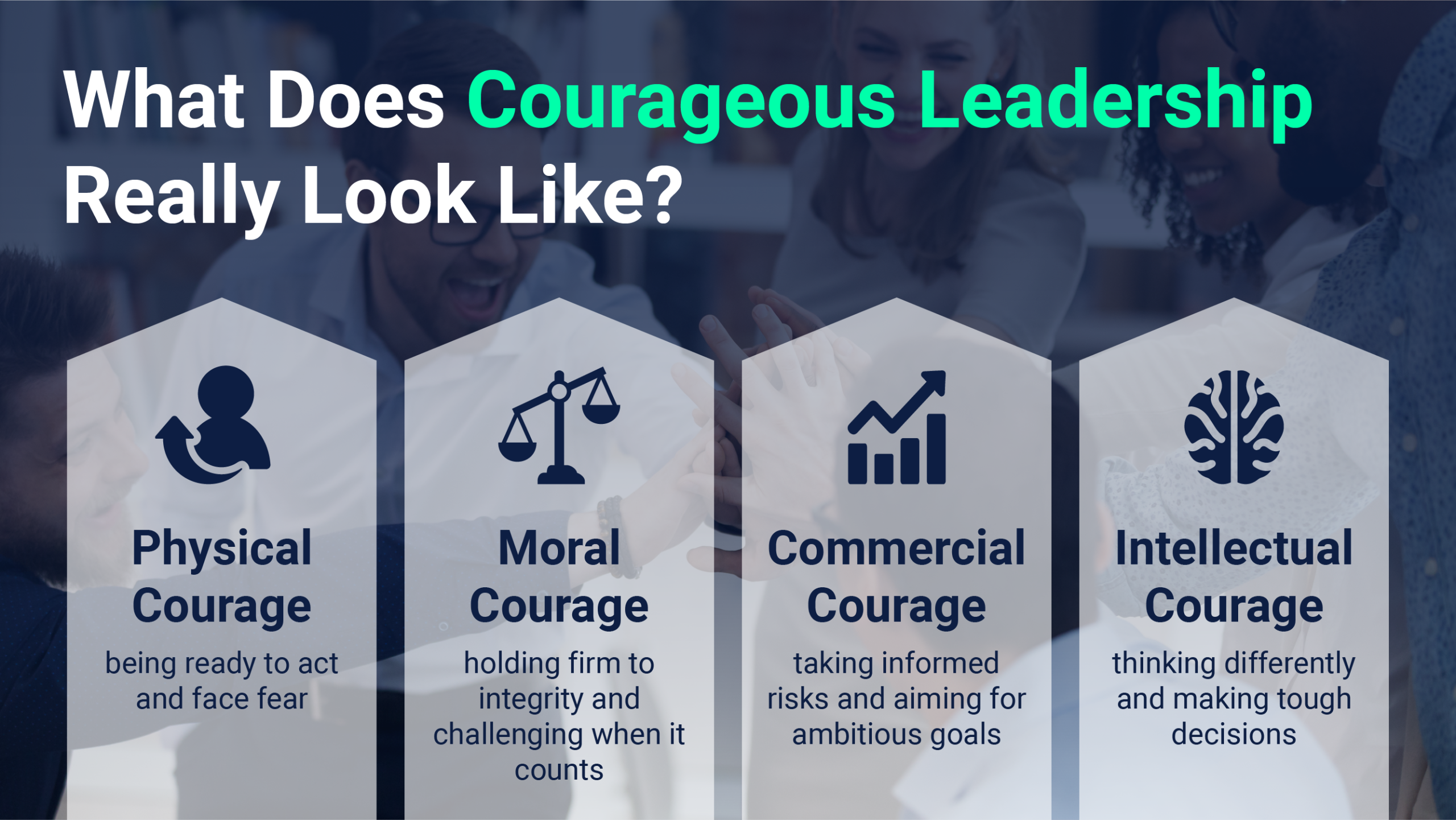
We explored four dimensions of courageous leadership:
Intellectual courage: thinking differently, reframing challenges as learning opportunities.
- Commercial courage: taking calculated risks, setting stretching goals that move teams beyond mediocrity.
- Moral courage: doing the right thing, challenging when needed, and admitting mistakes.
- Physical courage: overcoming fear, modelling resilience, and demonstrating boundaries and self care.
Interestingly, participants found moral courage came most naturally, while commercial courage felt least instinctive.
A virtuous cycle
Leaders play the crucial role of going first. By admitting mistakes, asking questions, or challenging assumptions, they set the tone for others to do the same.
This creates a virtuous circle:
- Leaders demonstrate courage, teams feel safer
- Teams act with courage, safety is reinforced.
- Increased safety, more openness, performance, and trust.
Of course, the opposite is also true: if leaders fail to model courageous behaviour, safety erodes and teams spiral into silence and disengagement.
Practical takeaways for leaders
- Frame challenges as learning opportunities to encourage intellectual courage.
- Admit mistakes openly to model moral courage.
- Seek input early and often to build commercial courage.
- Model resilience and self care to demonstrate physical courage.
“Small acts of leadership can shift culture in powerful ways.”
Small acts of leadership can shift culture in powerful ways.
You may also like...
Most leadership development programmes teach people what to think. Leadership simulation exercises put them in conditions where they have to think, decide and act. Under...
VIEW ARTICLE
What does structured leadership development actually return? After 19 years of delivering FUSION, a year-long programme for HSBC, we have a considered answer. Drawn from...
VIEW ARTICLE
AI is rapidly becoming embedded in everyday work. The real challenge for organizations is no longer technology adoption, but how leaders exercise judgement and governance...
VIEW ARTICLE