Why Leadership Simulation Exercises Are One of the Most Powerful Tools in Development

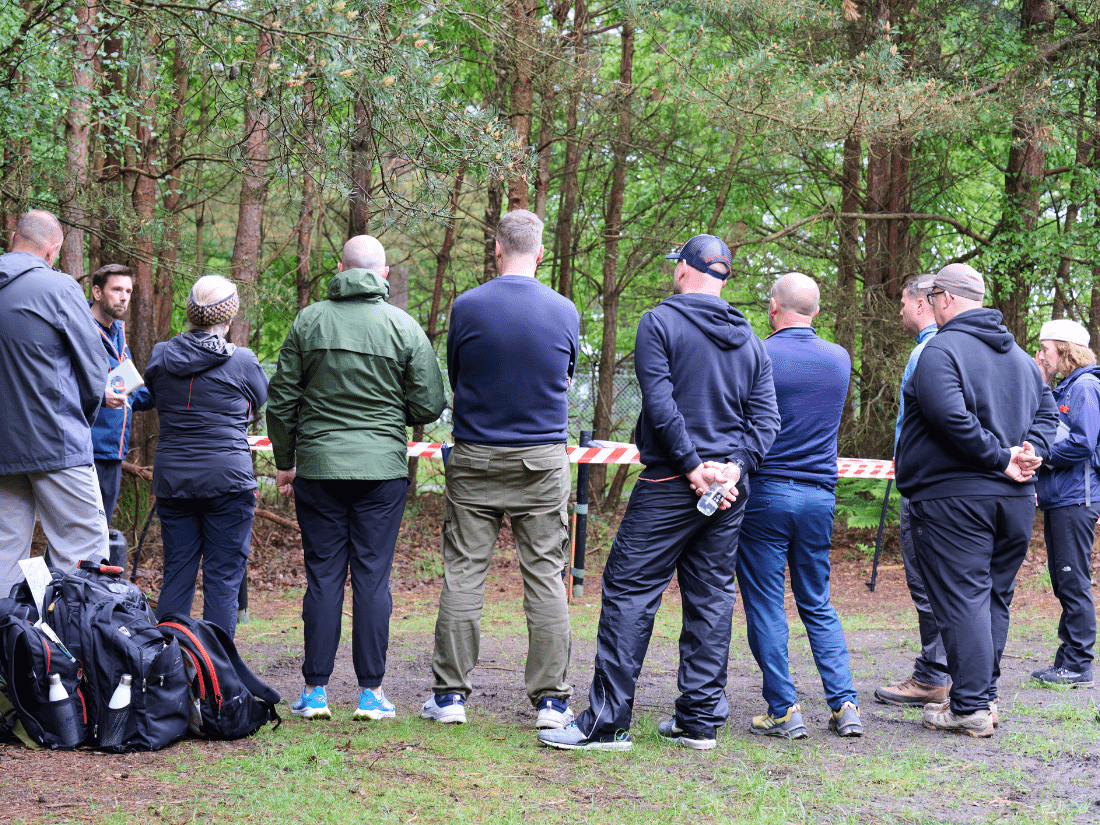
Most leadership development programmes teach people what to think. Leadership simulation exercises put them in conditions where they have to think, decide and act. Under pressure, in real time, with consequences. At Inspirational Group, we call them SimExs.
That distinction matters commercially. Organizations invest significantly in developing their people, yet the gap between learning and application remains stubbornly wide. Research consistently shows that people forget up to 70% of new information within 24 hours of passive training.¹ The behavioural change that organizations actually need: improved decision-making, stronger execution, more effective stakeholder engagement, requires a different kind of intervention.
SimExs are that intervention. But their value goes beyond accelerating learning. There is a critical distinction between developing leadership skills and building leadership capability, and it is a distinction that matters most when the pressure is real.
Skills are what you know how to do. Capability is what you actually do when conditions are difficult, time is short, information is incomplete and the stakes are high. You cannot develop the latter through instruction alone. There is a reason military training has always been simulation-heavy: when the moment comes, there is no time to recall a framework. The response has to be instinctive, forged through experience, not theory. That same principle applies in the boardroom, in a crisis, and in every high-stakes leadership moment that organizations face.
SimExs build that depth of capability. When designed well and embedded purposefully within a development programme, they create the conditions for people to find out, often for the first time, what they are genuinely capable of under pressure.
Why Passive Learning Falls Short
The evidence on learning retention is unambiguous. Passive approaches (lectures, presentations, reading material) produce low retention and limited behavioural transfer. Active learners, by contrast, have been shown to retain up to 93.5% of information after one month, compared to 79% for passive learners.²
This is not a marginal difference. It has direct implications for the ROI of any leadership development investment. An organisation that spends significant resource on a programme, only to see minimal shift in how people actually lead and make decisions, has not addressed its performance risk. It has deferred it.
The case for experiential, simulation-based learning is therefore not primarily educational. It is commercial. Development activity that produces measurable behaviour change is worth investing in. Activity that does not is a cost with limited return.
What Leadership Simulation Exercises Develop: Why It Is Hard to Replicate Otherwise
Leadership simulation exercises create the conditions for a specific and valuable category of learning: behaviour under pressure. This is distinct from knowledge of what good behaviour looks like, which can be conveyed through conventional training. SimExs force participants to demonstrate it.
The skills most consistently developed through simulation include:
- Decision-making under time pressure and incomplete information
- Leadership and followership dynamics within teams
- Stakeholder engagement across hierarchies and functions
- Communication and coordination in high-tempo environments
- Commercial awareness and consequence management
- Personal resilience and performance under stress
These are not soft skills in the colloquial sense. They are the behavioural competencies that determine whether strategy gets executed, whether leaders perform in critical moments, and whether organizations maintain alignment when conditions become difficult. Their absence represents genuine performance risk.
The Inspirational Group Approach
Inspirational Group designs and delivers SimExs as purposeful development interventions: bespoke to the client, focused on defined outcomes, and built into broader programmes to amplify learning rather than replace it. The range of formats we deploy reflects the breadth of performance challenges our clients face.
Strategic Development Programme
For the senior executive cohort of a global industrial manufacturing client, we designed and ran an overnight simulation (running from 1600 to 0900) as the centrepiece of a five-day programme. The client’s objective was to create genuine pressure: testing decision-making and character not in optimal conditions, but when people are tired, stressed and facing escalating complexity. The SimEx ran as a fluid, multi-phase operation throughout the night, with actors representing senior, peer and junior stakeholders, and structured hot debriefs following each phase.
The Global Head of L&D described the impact as enabling leaders to move beyond what they thought was possible. For a 28-year veteran of the business to characterise it as the most useful development experience of his career says something significant about the gap between what conventional programmes achieve and what a well-designed SimEx can unlock.
Commercial Programme: Business Simulation
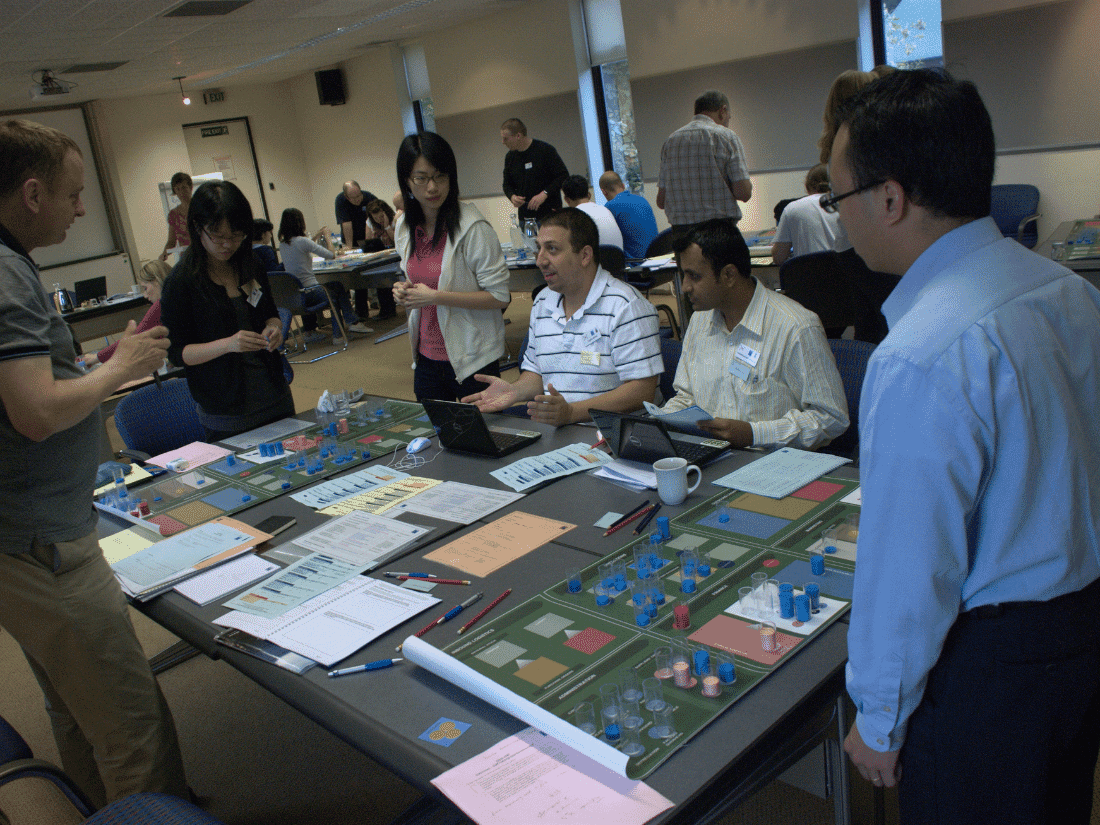
Our commercial simulation, based around a manufacturing scenario but adaptable to any client industry, is designed to develop commercial awareness, leadership, followership and cross-functional partnership. The mechanics are deliberately pressurised. Participants can engage with it at different levels of complexity: from foundational business literacy (understanding how commercial decisions connect to financial outcomes) through to board-level strategy simulation, where the focus is on multi-cycle decision-making and its consequences.
The programme is well-suited to audiences from graduate entry through to mid-career and senior leadership, a range that reflects its flexibility as both an onboarding tool and a strategic development intervention.
Leaders Programme: Tabletop Humanitarian Response
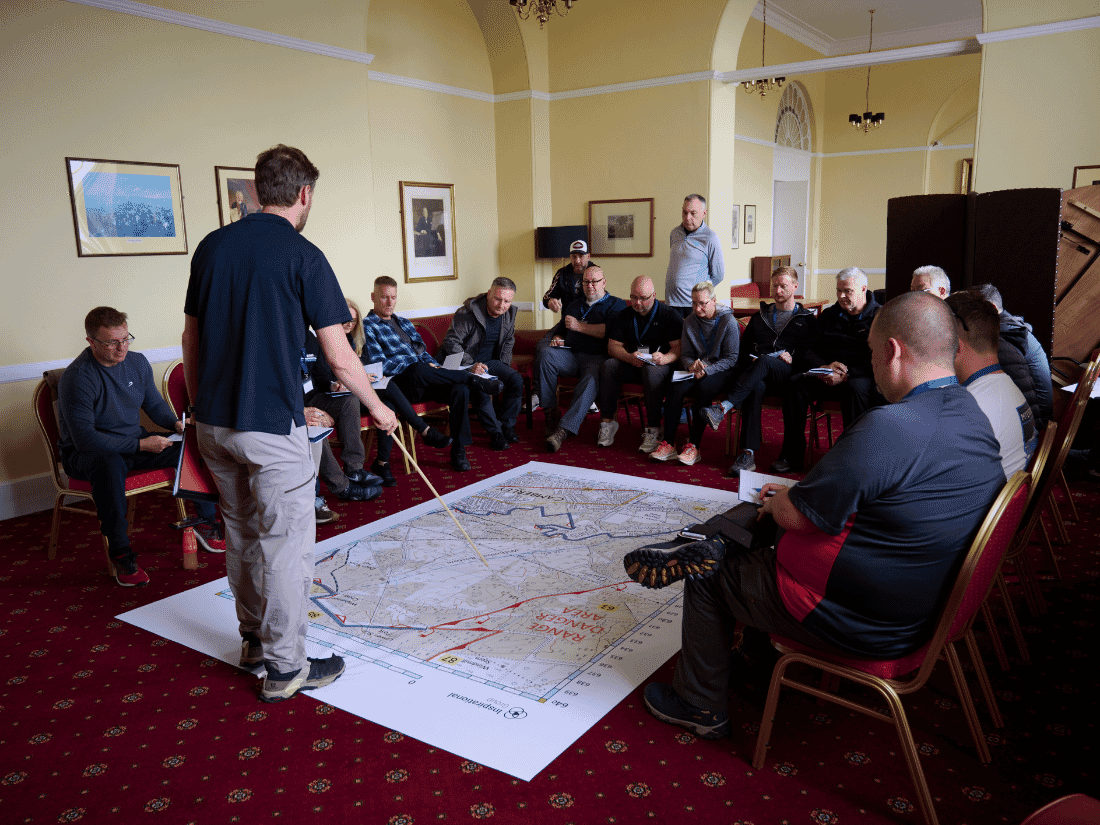
An indoor, tabletop SimEx built around a humanitarian rescue response scenario formed the centrepiece of another client’s five-day leadership programme, with an element of the programme run at the Royal Military Academy Sandhurst. Over one and a half days, delegates moved through a structured crisis, testing leadership and followership skills under pressure. Actors were used throughout to add realism and complexity. Post-SimEx reflection and structured debrief were integrated into the programme architecture.
The deliberate combination of physical environment, realistic scenario, professional actors and rigorous debrief creates the conditions for genuine insight: not just about what people did, but about why, and what they would do differently.
Outdoor SimExs: Large-Scale Field Operations
For organizations seeking a large-scale, physically immersive experience, we design and run outdoor field simulations built around complex scenarios. Multiple teams are deployed into an area of operations, where they must solve challenges, navigate the environment and communicate effectively to complete their mission. A concurrent escalating issue, initially requiring broader situational awareness then demanding a rapid shift in focus and tempo, adds a second layer of complexity that tests adaptability and coordination under pressure.
The format is highly scalable, from small groups through to hundreds of participants, making it equally applicable to high-potential cohort programmes and large-scale organizational interventions.
Digital and Online SimExs: The Actee Partnership
Not all simulation has to be physical. As a partner of Actee, a specialist developer of serious games and digital simulations for workplace learning, Inspirational Group integrates online and hybrid simulation formats into client programmes where appropriate.
Actee’s platform offers a library of simulation games covering change management, leadership dilemmas, commercial decision-making, stakeholder dynamics and more, all grounded in established behavioural theory including Kotter’s change model, Goleman’s leadership styles and complexity thinking. Games can be facilitated face-to-face or entirely online, making them accessible regardless of geography or group size.
Leading organizations including Danske Bank and Deutsche Telekom use Actee simulations as part of their development architecture.
Deutsche Telekom found the digital format equally effective in-person and virtually, with participant feedback exceeding expectations. The ability to combine high-intensity, in-person SimEx experiences with digital simulation formats gives Inspirational Group the range to meet clients across the full spectrum of their development needs, from immersive overnight exercises through to scalable online interventions that can be deployed globally.
Design Principles That Determine Impact
The effectiveness of any leadership simulation exercise is inseparable from the quality of its design. The following principles inform how Inspirational Group approaches this:
- Outcome-led design: every SimEx is built backwards from the specific behaviours and capabilities the client needs to develop or assess
- Programme integration: SimExs are most effective when embedded within a broader learning architecture, with structured preparation and post-exercise reflection
- Realism without redundancy: the level of scenario complexity and pressure is calibrated to the development objectives, not manufactured for spectacle
- Structured debrief: hot debriefs following each phase, and a deeper parallel-drawing session at the close, are not optional extras. They are where much of the learning is consolidated
- Measurement: post-programme re-measurement is built into our approach, ensuring impact is assessed, not assumed
The Commercial Case
The argument for leadership simulation exercises ultimately rests not on learning theory, but on performance outcomes. Research from Harvard Business School found that when leaders participated in simulation-based experiences as part of their development, overall organizational performance rates increased, with measurable improvement across client outcomes, productivity and engagement.
The ROI logic is straightforward. Simulation-based development is the most effective method for producing durable behaviour change, and the evidence strongly supports that conclusion. The question is not whether leadership simulation exercises are worth the investment. It is whether conventional development approaches can afford to remain the default.
For organizations operating under performance pressure, managing execution risk, closing capability gaps, or preparing leaders for complex and fast-moving environments, SimExs are not a premium option. They are a commercially rational response to a measurable performance challenge.
Find Out More
Inspirational Group designs and delivers bespoke simulation exercises for clients across UK, Europe, the Middle East and India. Whether you are looking to integrate a SimEx into an existing programme, or explore what a tailored experience might look like for your organisation, we would welcome the conversation.
References:
¹https://www.bizlibrary.com/blog/learning-methods/learning-retention-key-employee-training/²https://www.getbridge.com/blog/learning-analytics/10-stats-about-learning-retention-youll-want-forget/
FAQs
Leadership simulation exercises are structured, immersive experiences that place participants in realistic, high-pressure scenarios to develop decision-making, leadership and team performance skills. Unlike classroom training, they require people to act, not just learn.
Traditional training delivers knowledge. Leadership simulation exercises build capability: the ability to perform under pressure, in real time, with consequences. Research shows experiential learning produces retention rates of up to 90%, compared to as low as 5% for passive methods.
They develop decision-making under pressure, stakeholder engagement, leadership and followership dynamics, commercial awareness, communication in high-tempo environments, and personal resilience.
Format and duration vary significantly depending on objectives. Exercises can run from a focused half-day commercial simulation through to an intensive overnight programme spanning 16 or more hours.
Yes. Digital simulation formats, including those developed through our partnership with Actee, can be facilitated entirely online or in hybrid settings, making them accessible regardless of geography or group size.
Impact is assessed through structured post-exercise debrief, participant reflection, and post-programme re-measurement in partnership with the client, ensuring outcomes are demonstrated rather than assumed.
You may also like...
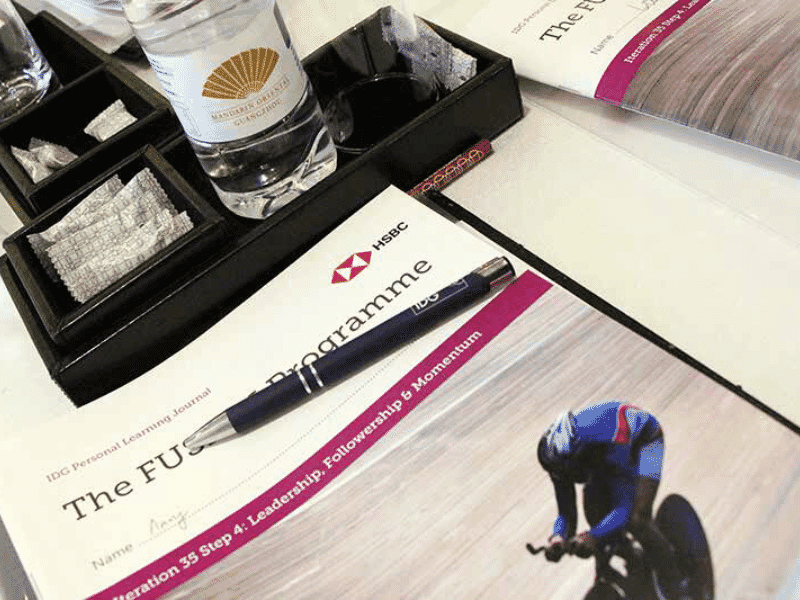
What does structured leadership development actually return? After 19 years of delivering FUSION, a year-long programme for HSBC, we have a considered answer. Drawn from...
VIEW ARTICLE
AI is rapidly becoming embedded in everyday work. The real challenge for organizations is no longer technology adoption, but how leaders exercise judgement and governance...
VIEW ARTICLE
Most organizations track activity during change. Few truly measure change progress. When reporting masks drift, leaders lose visibility until the cost is already embedded.
VIEW ARTICLE