The Power of Positivity in the Workplace


In this blog, leadership expert, executive mentor and CMI Chartered Companion Nigel Girling talks about the considerable impact Positivity has on a workplace, not just in terms of an attitude, but also in the things that we do for our colleagues.
Academics are an interesting bunch. A tribe, one might say.
They particularly love to do research and come up with conclusions that they can then publish. For a lot of them, it’s necessary to maintain their position within an institution. It’s also often the process by which they achieve or maintain a professional reputation and standing.
The trouble is this…. (IMHO. Though frankly my opinion has never been all that humble). They get so hung up on the methodology, accuracy and phrases like mathematical algorithms, representative sampling and empirical evidence that they often entirely miss the most important insights.
The quantity of articles and papers over recent years, attempting to debunk the claims of two psychologists about the title of this piece are a case in point – and a salutary lesson for those more interested in principles and their application than data. Which I suggest should include you, in case that wasn’t clear.
Fredrickson & Losada (2005) conducted a study which purported to have defined a mathematical relationship between the effect of positive versus negative emotions on mental health & wellbeing. It was a major output of the emerging field of positive psychology and something that many have referenced since in promoting the need for the concept of positivity to be taken more seriously.
Their study suggested that there was a ‘critical positivity ratio’ that affected mental health & wellbeing that could be calculated and was consistent – that ratio being 2.9 to 1 – or more simply, that experiencing about three positive emotions to every negative one was key to promoting and improving wellbeing.
Now, almost twenty years later, papers continue regularly to be published claiming to ‘debunk the findings’. I know, I’ve read many of them (Yes, I’m living the dream).
Almost without exception, the gist of these papers is to throw doubt on the mathematics and algorithm used in the original research. Presumably these academics all have a PhD in the science of entirely missing the point. I don’t care if the maths was flawed and whether the correct ratio should actually be 2.453 recurring – and neither should you.
The far more helpful everyday sciences of common sense and observation tell us that the principle that experiencing positive emotions much more frequently than negative ones improves wellbeing is sound.
But so what?
Current thinking in some quarters is that the idea of ‘micro joys’ may help all of us at work and at home and I offer it here, for your consideration.
Put simply, this is the art of finding joy in the little things.
A friend getting a puppy and sending you pictures. The sun suddenly coming out in the Winter. Trees starting to show early Spring blossom. Someone praising or simply recognizing your efforts. A colleague unexpectedly bringing you coffee or a cake.
Crucially, similar psychological and wellbeing benefits can accrue from you performing similar acts of kindness for someone else.
To some extent, this is part of the whole ‘glass half empty vs glass half full’ debate that I’ve written about several times. Those who are in the ‘half empty’ camp are more likely to miss or dismiss those micro joys. They may see them as trivial. Distractions. Pointless. Just leave me alone I’m busy. Oh, just get on with your work and stop wasting my time.
Some may view this as ‘pseudo-science’ or happy-clappy nonsense. I’d be prepared to bet that those people spend much of their time in the ‘half empty’ camp. Furthermore, I’d warn them that this may not be good for either their own mental health & wellbeing, nor for that of the many people on whom they have an impact – at work and at home.
Now for my contribution to the science bit: I work in the field of cognitive science. My interest is in studying the way people think, why they think that way, what effect that has on them and how it shapes the way they interact with others.
Much of this work focuses on leaders and leadership, as those individuals tend to have the greatest impact on the largest number of individuals. Ok, back to the science.
Research from a number of significant institutions, such as Ireland’s Royal College of Surgeons and a number of prominent universities and medical institutions across the globe, shows that experiencing joy has a profound impact on both mind and body. It creates chemical reactions which positively affect our mood and behaviour. It increases life expectancy and reduces the likelihood of life-threatening illnesses.
The reverse, however, is also true. Negative emotions – especially when experienced over a prolonged period, can result in over-production of a range of hormonal responses including cortisol. Scientists at Harvard and the National Institute of Health have identified that low-level stressors such as worry, anxiety, isolation and poor relationships often result in health impacts such as increased risk of diabetes, heart conditions, depression or simply low mood.
Consciously recognizing moments of joy and positive experiences is very likely to be an effective counter to these outcomes and tends to increase resilience and optimism.
Take joy wherever you can find it in the everyday. Spread it to others. You’ll have a better life and so will they.
You may also like...

Most leadership development programmes teach people what to think. Leadership simulation exercises put them in conditions where they have to think, decide and act. Under...
VIEW ARTICLE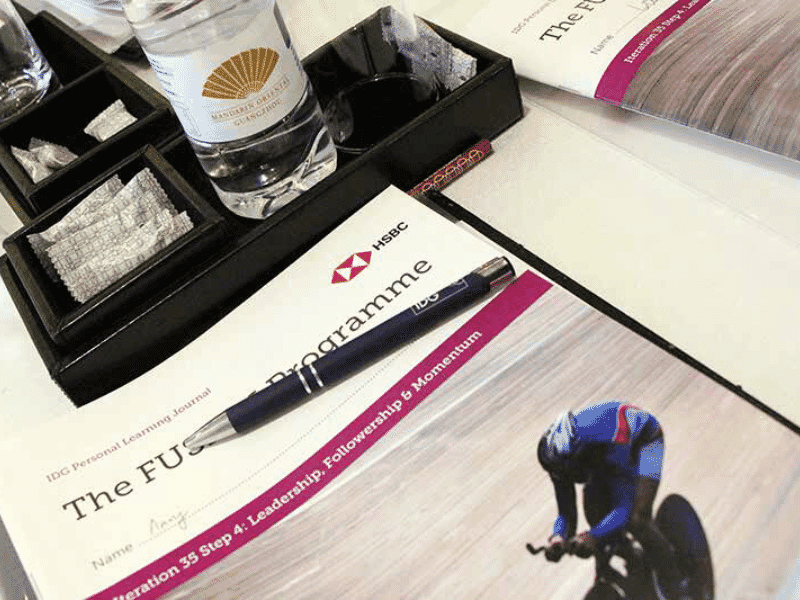
What does structured leadership development actually return? After 19 years of delivering FUSION, a year-long programme for HSBC, we have a considered answer. Drawn from...
VIEW ARTICLE
AI is rapidly becoming embedded in everyday work. The real challenge for organizations is no longer technology adoption, but how leaders exercise judgement and governance...
VIEW ARTICLE