Why Do We Need Purpose-Driven Leadership?


Purpose-driven leadership has become a necessity in a world where nations, communities, organizations and employees are experieincing near-constant change. Disruption is everywhere: socially, politically, environmentally, economically. Whilst it is a subjective viewpoint, there is an argument to be made that there has never been such wide-spread, all encompassing volatility in our history.
Yet many organizations ignore it or make token gestures, often driven by PR value. We need to find a better way: a better business model, better working lives and more balanced demands on the planet we all share – and we need purpose-driven leadership to find it. At Inspirational Group, we call it “leadership for a better tomorrow”.
Why do we need to be driven by purpose?
• The next generation demands it. People with very different goals, expectations and concerns to those of their parents’ and grandparents’ generations. These are the new recruits of today and tomorrow – and the leaders of the very near future. The resulting transformation of the whole business landscape is inevitable. The tomorrow that will be built by these Millennials and Generation Z will be very different to the world of today – a world largely created by Baby Boomers and Generation X. Business as usual is no longer an option. We need a different approach to leadership and to business.
• Investors want to see it. They are moving their support into organizations that are seen to be doing ‘good work’ – and asking tough questions about the impact the organization is having on the world. CEOs are being held to account for their decisions, ethics and behaviour, not just the financial performance of their organization. Those questions will get harder.
• Employees expect it. Most organizations in the developed world are struggling to recruit and retain talented people. They face rising costs and falling profits, see falling levels of engagement from their employees, find it difficult to innovate and are faced with a range of wellbeing and mental health challenges that are significantly damaging their performance, in often hidden ways. Inclusion in these organizations is often way behind the expectations of younger generations and is wasting swathes of talent and ideas. Leader behaviour is under constant scrutiny. All these issues have major impacts on public image and market position. This is way more than just ‘a nice thing to do’ or ‘good PR’.
• The planet needs it. The whole environment is on a knife edge. Global warming is killing people and animals and destroying swathes of the land. If we don’t reverse the trend, millions will die and organizations will collapse. It’s scientifically proven and a truth that leaders cannot – must not – ignore. The culture of working to satisfy the desires of shareholders above all, while chasing bonuses and measuring success by purely financial indicators is dangerous and pushing organizations into obsolescence.
Purpose-driven leadership simply means that leaders are the people responsible for addressing these challenges. They are the ones who need to find better ways to collaborate, engage, inspire and align people in the service of a worthy purpose. For many leaders, especially those with the most experience, this may not be an easy or natural thing to do.
The age of the ‘boss’ is over in most places. Traditional ‘Management’ approaches will not pull us back from this edge. People look to their leaders to show integrity and grit in facing the challenges and really leading people into that better tomorrow.
Leadership – really being the leaders that people need – is about stepping up to provide the inspiration, unity, culture and leadership approach that will enable organizations to thrive tomorrow and support their people to engage, commit and achieve peak performance.
That doesn’t just mean those at the top or those in Government, it means leaders everywhere.
The essence of ‘Leadership for a Better Tomorrow’ can be found in the ‘Triple Bottom Line’ and B Corp. The idea that the purpose of business is to deliver benefits in terms of People, Planet & Prosperity is often called the ‘3 Ps’ or ‘3BL’ for simplicity. Organizations who commit to this are designing their whole operation to be regenerative – to put back more than they take out and to have a positive impact on the 3BL of people, planet and prosperity.
While 3BL has been adopted widely in financial and accounting practice, it was initially conceived 30 years ago to be so much more than that. Had the call to action been heard and understood then, the need would be far less pressing than it is today. The creator of 3BL, John Elkington, now recognizes that adopting 3BL must now be an early step on a much longer road. The challenges are so much greater today than in 1994 and the world’s population so much larger – 5.6 billion in 1994, more than 8 Billion in 2024 and forecasted to reach around 10 Billion by 2050. Yet as recently as 1959 it was below 3 Billion.
A trebling of human impacts on our planet in the span of a single life. Business and the race for profits and material gains has caused much of the damage. Only leadership for a better tomorrow can turn back the tide.
A better tomorrow is possible. But no tomorrow at all is also possible.
The choice is in the hands of leaders and major organizations.
Inspirational Group’s purpose is to inspire leadership for a better tomorrow. We exist to ignite the spark in every delegate, and in every client, so they become more successful by adding value to their bottom line, to their people, and to the planet.
Get in touch using the form below to find out how we can help you find and deliver purpose for your people and your organization.
Photo by JOHN TOWNER on Unsplash
You may also like...
Most leadership development programmes teach people what to think. Leadership simulation exercises put them in conditions where they have to think, decide and act. Under...
VIEW ARTICLE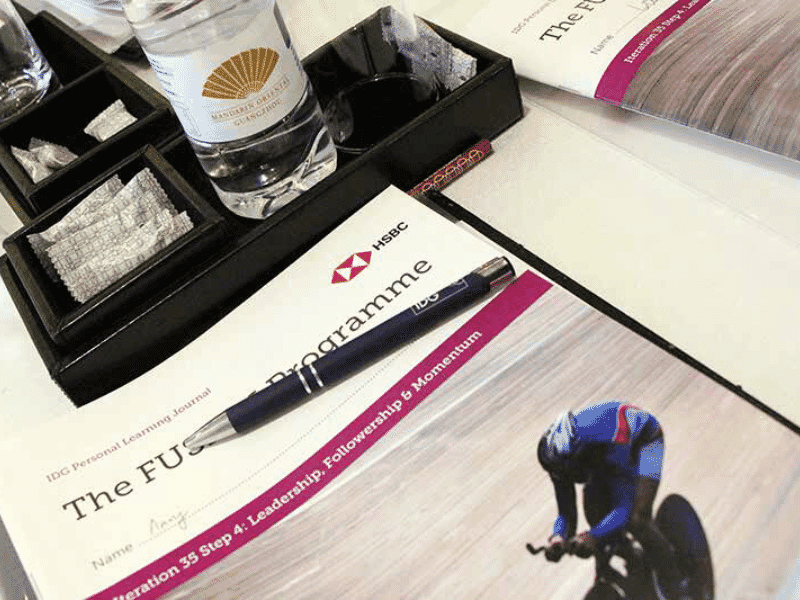
What does structured leadership development actually return? After 19 years of delivering FUSION, a year-long programme for HSBC, we have a considered answer. Drawn from...
VIEW ARTICLE
AI is rapidly becoming embedded in everyday work. The real challenge for organizations is no longer technology adoption, but how leaders exercise judgement and governance...
VIEW ARTICLE