We Asked Leaders What They Really Think About AI. The Answer Wasn’t What We Expected

There’s no shortage of data on AI adoption. 78% of organizations now use it in at least one business function, investment is accelerating, and the technology is embedding itself faster than most governance frameworks can keep pace with.
But there’s a question the adoption data doesn’t answer. Do the people making decisions with AI actually trust it? We decided to find out.
Last month, Inspirational Group conducted primary research into AI trust among senior leaders, using our own AI Interview Avatar technology. We didn’t send a survey – we had a conversation. And what came back was striking, and much more nuanced than any headline figure could capture.
The finding that stopped us
The mean trust score across our participants was 5.4 out of 10. Respectable, but unremarkable. And no one scored above 8. Not one respondent offered unconditional trust.
But the number that told us the most belongs to one participant who gave two scores: 3 for pure AI-generated content, and 8 for AI content with visible human involvement. That’s a five-point gap!
And it changed the question entirely. Because it highlighted that leaders don’t distrust AI, they distrust AI without accountability.
What that means in practice
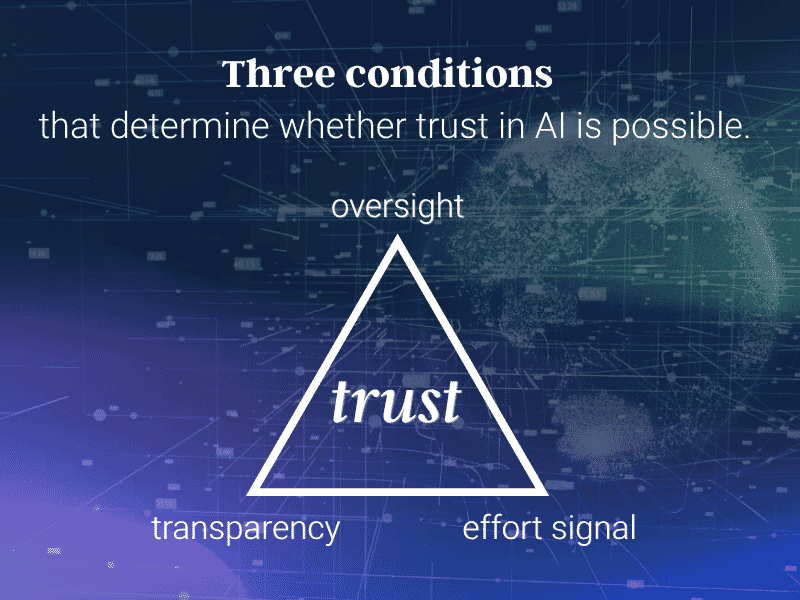
The full research – which forms the basis of our forthcoming whitepaper, Trust in AI: What Leaders Really Think – identifies three conditions that consistently determine whether trust is possible.
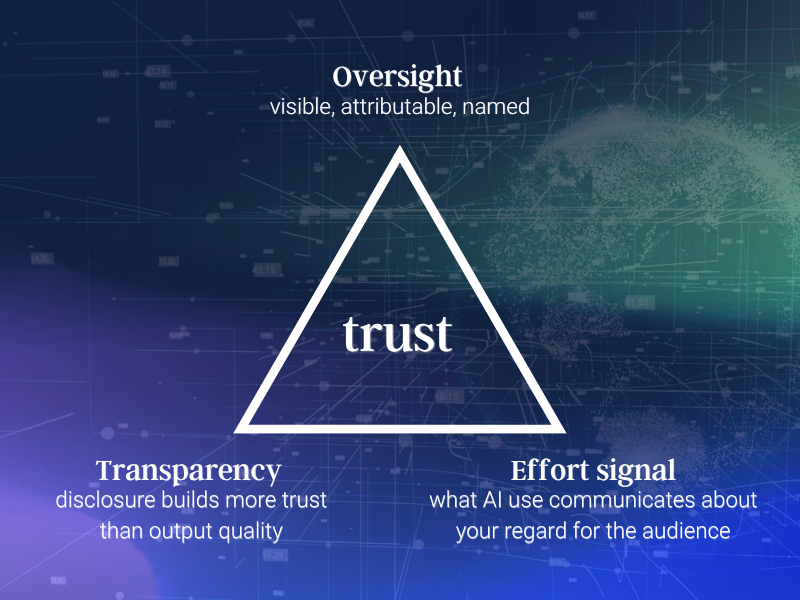
The first is human oversight, but oversight that’s visible and attributable. A named person who has reviewed the output and taken responsibility for it. The trust uplift from this isn’t incremental – in the data, it’s transformative.
The second is transparency. Participants didn’t need AI to be perfect, they needed to know it had been used. Disclosure, it turns out, does more to build trust than any improvement in output quality.
And the third is what we’ve called the effort signal, which is the degree to which using AI carelessly communicates something about the sender’s regard for their audience. This is the finding that surprised us most, and it reframes AI governance from a technology question to a leadership character question.
Why this matters now
We’re publishing this research because the trust conversation is lagging far behind the deployment conversation. Most organizations are deploying AI at speed – often without disclosure, and often without visible human accountability – whilst their leaders and clients are only comfortable with something more considered.
The gap between those two positions isn’t a technology gap, it’s a governance and culture gap. And it’s one most organizations could begin to close tomorrow.
Download the whitepaper
Get the full findings from one of the first pieces of primary research into how senior leaders think about AI trust and accountability.
an Trust Signals that AI has Forgotten covers the full research findings, a practical framework for organizations to assess where they sit, and five evidence-based recommendations for building AI trust from the inside out.
You may also like...

Many men are unprepared for menopause, and few see a role for themselves in supporting it. Yet leaders influence whether women are supported or withdraw...
VIEW ARTICLE
Four programmes for 2027 planning: aligning leadership teams on measurable priorities, building emotional intelligence under pressure, developing people managers and growing the pipeline of women...
VIEW ARTICLE
A strategy planning session usually ends with a deck and a shared sense of direction. Here is what a leadership team should leave with to...
VIEW ARTICLE