Why the Building Society Sector’s Biggest Challenge Is Not Technology

I spent two days in Edinburgh at the Building Societies Annual Conference, listening. Not presenting, not exhibiting. Listening. The sector had a great deal to say.
Around 1,100 delegates gathered at the Edinburgh International Conference Centre across 28 and 29 April. The agenda was sharp: AI, regulation, growth strategy, member engagement, the future of mutuality. The conversations were sharper still.
What struck me most was not what the sector is worried about. It was the gap between what it knows it needs to do and its confidence in being able to do it. That gap is not a technology problem, it is a people one. And it is one that the sector, in its own words, named repeatedly across two days.
What the Data Actually Said
Live delegate polling at the conference produced some of the most direct sector intelligence I have encountered. A few figures stand out.
Live delegate polling at the conference produced some of the most direct sector intelligence I have encountered. A few figures stand out.
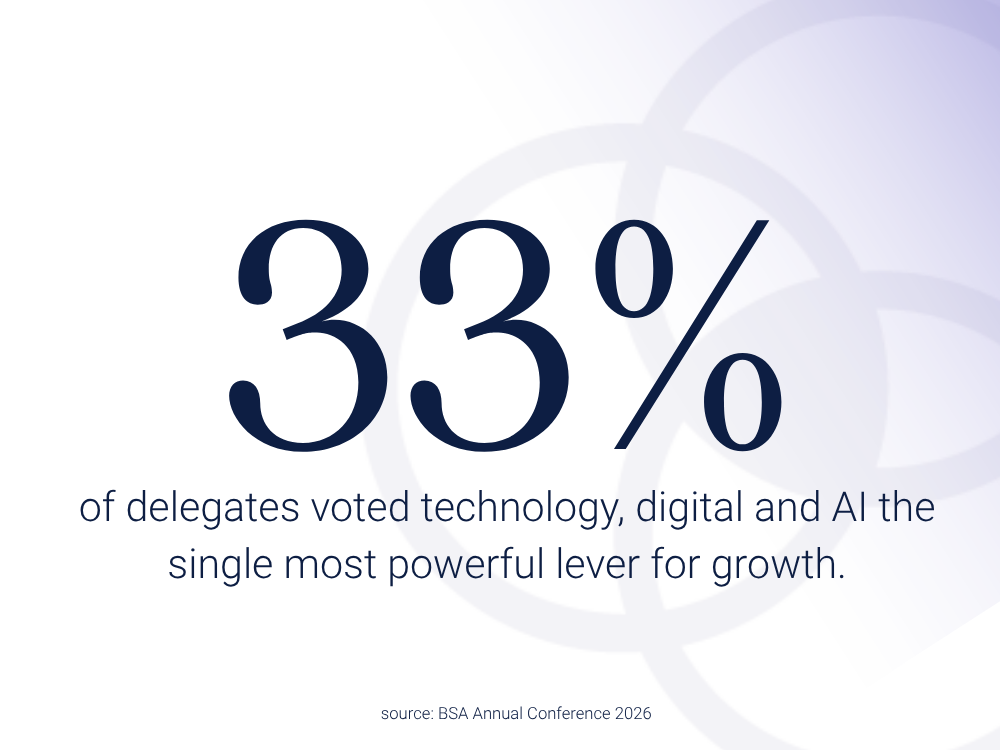
Technology, digital and AI was voted the single most powerful lever for growth by 33% of delegates. Yet only a small proportion of financial services firms have scaled AI across their enterprise. The aspiration is clear. The execution is not.
On growth ambition, the sector is genuinely divided. Around a third are content with steady, measured growth of 7 to 15% per year. An almost equal proportion feel the urgency to grow at challenger bank pace. That is not a consensus. That is a sector navigating a strategic fork in the road without a shared map.
Proportionate regulation was the standout policy ask, chosen by 37% of delegates as the single most important change needed. The FCA and PRA presented on next steps following the Mutuals Landscape report. The government signalled a commitment to doubling the size of the mutual sector framework. The removal of the sourcebook creates both opportunity and significant governance responsibility for boards.
The AI Confidence Gap
The conference confirmed what we already suspected. Most building societies sit at what one presenter described as the Foundation stage of AI adoption: aware of the technology, running pilots, but not yet operating at scale or with genuine confidence.
This is not a criticism. It reflects the reality of operating in a regulated environment where explainability, auditability and member trust are non-negotiable. The FCA’s Consumer Duty framework is already accelerating the need for AI decisions that can be justified, traced and defended. That is a governance question as much as a technology one.
The institutions that move early on responsible AI governance will gain a measurable competitive and regulatory advantage. But moving early requires boards and executive teams who understand what they are governing. Most do not yet have that confidence.
This is not a technology gap.
Change Is a People Problem, Not a Technology Problem
One of the most direct observations made across the conference came from a technology leader in the sector: change is about people, not about technology.
It sounds obvious. It is rarely acted on.
Every building society in the room was mid-transformation in some form: digital channel migration, core system modernisation, Consumer Duty embedding, post-merger integration, AI adoption. The roadmaps exist. The investment has been made or committed. The stumbling block, almost without exception, is the capability of leaders to take people with them through change at pace.
Cultural resistance was identified as one of the key systemic barriers preventing AI from moving beyond pilot stage. Resilience, not just operational resilience in the regulatory sense but personal and organizational resilience, was a repeated theme across informal conversations.
The sector has the strategy. It does not always have the behavioural capability to execute it.
Why Smaller Institutions Face a Particular Challenge
The major banks have dedicated change functions, internal L&D infrastructure, and the headcount to absorb transformation costs. Mid-tier banks, building societies and specialist lenders face identical regulatory obligations with a fraction of those resources.
Consumer Duty, SM&CR, operational resilience, digital transformation: none of these carry a proportionality clause based on organizational size. The obligations are the same. The internal capacity to meet them is not.
This creates a specific and urgent need for external support that goes beyond compliance advisory. The institutions that will navigate this period well are those that invest in the leadership capability, commercial skills and change competence of their people, not just in technology and process.
The conference made this case compellingly, not through external argument but through the sector’s own voice.
Four Capability Priorities the Sector Named
Drawing on conference discussions, polling data and conversations across both days, four capability areas emerged as genuinely urgent for building societies and mid-tier financial services firms.

AI Leadership.
Not AI implementation. AI leadership. Board members and executive teams who understand enough about AI to make good decisions about it, govern it responsibly and communicate about it credibly to regulators, members and staff. This is a distinct and developing need.

Commercial and Client Capability
Revenue in relationship-led financial services lives in the quality of client conversations. Relationship managers and commercial directors who can deepen engagement, identify needs early, are that trusted advisor – and differentiate on service rather than rate, are a measurable commercial asset. This is directly trackable in pipeline and retention data.

Change Leadership
The capability to lead, land and sustain change is acutely needed and chronically stretched in organizations navigating multiple simultaneous transformation programmes. Building change competence into the top tier of leadership is not a soft investment. It is risk mitigation.

Post-Transaction Culture Integration
Consolidation in the sector is accelerating. Nationwide and Virgin Money, Coventry and Co-op Bank, Newcastle and Manchester Building Society: each creates an immediate need for culture alignment, values embedding and leadership integration. The technical integration typically receives the investment. The human integration often does not.
What Good Looks Like
The building societies that will emerge from this period in the strongest position are not necessarily the largest or the most technologically advanced. They are the ones whose leadership teams are clear on direction, confident in decision-making and capable of taking their organizations with them through sustained change.
That is not a vague aspiration. It is a measurable state. Behaviours can be assessed, gaps identified, interventions designed and impact demonstrated through structured re-measurement. Performance is not assumed. It is evidenced.
The mutual model, at its best, is built on purpose, relationship and long-term thinking. Those are precisely the conditions in which high-performance leadership development works best. The sector has more going for it than it sometimes gives itself credit for.
The Edinburgh conversations confirmed that clearly.
About Inspirational Group
Inspirational Group is a human performance advisory and delivery partner. We work with financial services organizations to strengthen the leadership behaviours that drive execution, alignment and measurable performance improvement. Our work is evidence-based, commercially grounded and delivered with structured impact assessment.
If the themes in this article are relevant to your organization, we would welcome the conversation.
FAQs
The dominant themes across the two-day conference were AI adoption and leadership, proportionate regulation, growth strategy, member engagement and the future of the mutual sector. Live polling confirmed that technology, digital and AI was seen as the most powerful lever for growth, while enhanced board and executive capability was identified as the most underinvested enabler.
Most building societies are currently at the early stages of AI adoption, running pilots but not yet operating at scale. The challenge is less about technology implementation and more about leadership confidence: boards and executive teams that can govern AI responsibly, make sound decisions about it and meet the explainability requirements of FCA Consumer Duty. This is a leadership and governance capability gap as much as a technology one.
Consumer Duty accelerates the need for leaders who can embed a genuine customer-outcomes culture across their organizations, not just compliance processes. Positively the Mutual model and Consumer Duty are at their core pointing in the same direction but it requires behavioural change at every level, clear accountabilities under SM&CR, and the ability to demonstrate that good outcomes are being delivered. Leadership capability and culture are central to Consumer Duty delivery, not peripheral to it.
Smaller institutions face the same regulatory obligations as major banks and large building societies: Consumer Duty, SM&CR, operational resilience, digital transformation, but with significantly less internal resource to address them. They typically lack dedicated L&D infrastructure and often have limited leadership bandwidth for transformation. This creates an acute need for external capability support that delivers measurable impact efficiently.
Effective leadership development programmes are designed with structured pre and post measurement. Behavioural assessments, performance indicators and business outcome metrics establish a baseline before any intervention. Impact is then demonstrated through re-measurement at agreed intervals, typically three to six months post-programme. This approach connects development activity directly to business performance, making the investment case clear and the results auditable.
Effective change leadership in this sector combines clear strategic communication, the ability to manage cultural resistance, and the capability to sustain momentum across multiple simultaneous transformation programmes. It is not a personality trait. It is a set of learnable behaviours that can be developed, assessed and measured. Organizations that invest in change leadership at the top tier consistently outperform those that treat change as a process challenge rather than a people challenge.
When two organizations merge, the technical and financial integration typically receives the majority of investment and attention. The cultural integration, aligning values, leadership behaviours and ways of working, is often underfunded and underplanned. Research consistently shows that cultural misalignment is a leading cause of value destruction in mergers. With consolidation accelerating across the building society sector, culture integration is an increasingly urgent capability need.
Boards need sufficient understanding of AI to ask the right questions, not to become technical experts. This means understanding how AI decisions are made and how they can be explained, what the regulatory expectations are under Consumer Duty and emerging FCA guidance, and what governance frameworks are appropriate for AI deployment in a regulated, member-facing context. Building this confidence at board level is one of the most commercially valuable investments a building society can make in the current environment.
You may also like...

Many men are unprepared for menopause, and few see a role for themselves in supporting it. Yet leaders influence whether women are supported or withdraw...
VIEW ARTICLE
Four programmes for 2027 planning: aligning leadership teams on measurable priorities, building emotional intelligence under pressure, developing people managers and growing the pipeline of women...
VIEW ARTICLE
A strategy planning session usually ends with a deck and a shared sense of direction. Here is what a leadership team should leave with to...
VIEW ARTICLE